#include <Filter.h>
 Collaboration diagram for NetworkFilter: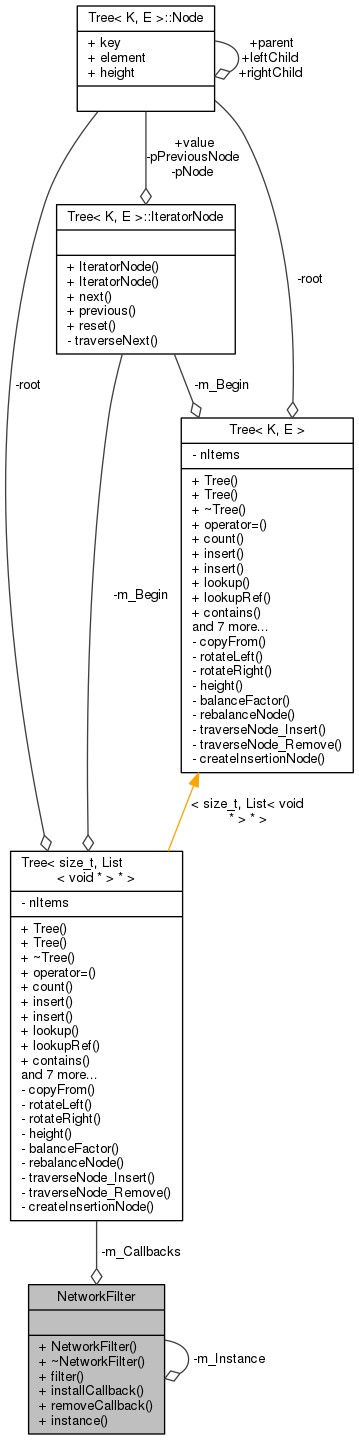
Classes | |
| struct | ActiveInvocation |
| struct | CallbackItem |
Public Member Functions | |
| NetworkFilter () | |
| Default constructor, boring. | |
| virtual | ~NetworkFilter () |
| Destructor, also boring. | |
| bool | filter (size_t level, uintptr_t packet, size_t sz) |
| size_t | installCallback (size_t level, bool(*callback)(uintptr_t, size_t)) |
| bool | removeCallback (size_t level, size_t id) |
Static Public Member Functions | |
| static NetworkFilter & | instance () |
Private Member Functions | |
| void | drainCallback (size_t level, CallbackItem *item) |
| bool | isCallbackInvocation (Thread *thread) const |
Private Attributes | |
| List< CallbackItem * > | m_Callbacks [4] |
| Spinlock | m_Lock |
| size_t | m_NextCallbackId |
| ActiveInvocation * | m_pActiveInvocations |
Static Private Attributes | |
| static NetworkFilter | m_Instance |
Detailed Description
Provides an interface for filtering network packets as they come in to the system.
Constructor & Destructor Documentation
◆ NetworkFilter()
| NetworkFilter::NetworkFilter | ( | ) |
◆ ~NetworkFilter()
|
virtual |
Destructor, also boring.
Definition at line 35 of file Filter.cc.
References Spinlock::acquire(), ProcessorBase::information(), Spinlock::release(), and removeCallback().
Member Function Documentation
◆ drainCallback()
|
private |
◆ filter()
| bool NetworkFilter::filter | ( | size_t | level, |
| uintptr_t | packet, | ||
| size_t | sz | ||
| ) |
Passes a Level n packet to filter callbacks. Level 1 is the lowest level, handling for example Ethernet frames. Level 2 handles the Level 1 payload. ARP, IP, and other low-level protocols are handled here. Level 3 handles the Level 2 payload. TCP, UDP, ICMP, etc... Level 4 handles the Level 3 payload. Specific application protocols such as FTP, DNS.
- Todo:
- Callbacks should be able to return a code which requests a specific response, such as ICMP Unreachable or something, rather than just dropping the packet.
- Parameters
-
level Level of callback to call packet Packet buffer, can be modified by callbacks size Size of the packet. Can NOT be modified by callbacks
- Returns
- False if the packet has been rejected, true otherwise.
Definition at line 60 of file Filter.cc.
References Spinlock::acquire(), ProcessorBase::information(), and Spinlock::release().
◆ installCallback()
| size_t NetworkFilter::installCallback | ( | size_t | level, |
| bool(*)(uintptr_t, size_t) | callback | ||
| ) |
Installs a callback for a specific level.
- Returns
- An identifier which can be passed to removeCallback to uninstall the callback, or ((size_t) -1) if unable to install.
Definition at line 141 of file Filter.cc.
References Spinlock::acquire(), and Spinlock::release().
◆ instance()
|
inlinestatic |
The design pattern everyone loves to hate!
Definition at line 43 of file Filter.h.
Referenced by NetworkStack::receive().
Here is the caller graph for this function:
◆ isCallbackInvocation()
|
private |
◆ removeCallback()
| bool NetworkFilter::removeCallback | ( | size_t | level, |
| size_t | id | ||
| ) |
Closes admission and removes a callback for a specific level.
Outside filter dispatch this waits for admitted calls and returns true once callback-owned state may be destroyed. During dispatch, an active target is disabled but retained and false is returned; the caller must preserve the identifier and callback-owned state, then retry from outside callback context. An already absent valid identifier is complete.
Definition at line 165 of file Filter.cc.
References Spinlock::acquire(), ProcessorBase::information(), and Spinlock::release().
Referenced by ~NetworkFilter().
Here is the caller graph for this function:
Member Data Documentation
◆ m_Callbacks
|
private |
◆ m_Instance
|
staticprivate |
◆ m_Lock
◆ m_NextCallbackId
◆ m_pActiveInvocations
|
private |
The documentation for this class was generated from the following files: