Collaboration diagram for Mutexes:
Functions | |
| err_t | sys_mutex_new (sys_mutex_t *mutex) |
| void | sys_mutex_lock (sys_mutex_t *mutex) |
| void | sys_mutex_unlock (sys_mutex_t *mutex) |
| void | sys_mutex_free (sys_mutex_t *mutex) |
| int | sys_mutex_valid (sys_mutex_t *mutex) |
| void | sys_mutex_set_invalid (sys_mutex_t *mutex) |
Detailed Description
Mutexes are recommended to correctly handle priority inversion, especially if you use LWIP_CORE_LOCKING .
Function Documentation
◆ sys_mutex_free()
| void sys_mutex_free | ( | sys_mutex_t * | mutex | ) |
Delete a semaphore
- Parameters
-
mutex the mutex to delete
Definition at line 355 of file sys_arch.cc.
Referenced by tcpip_shutdown().
Here is the caller graph for this function:
◆ sys_mutex_lock()
| void sys_mutex_lock | ( | sys_mutex_t * | mutex | ) |
Lock a mutex
- Parameters
-
mutex the mutex to lock
Definition at line 344 of file sys_arch.cc.
References Semaphore::acquire().
Referenced by mem_malloc().
Here is the caller graph for this function: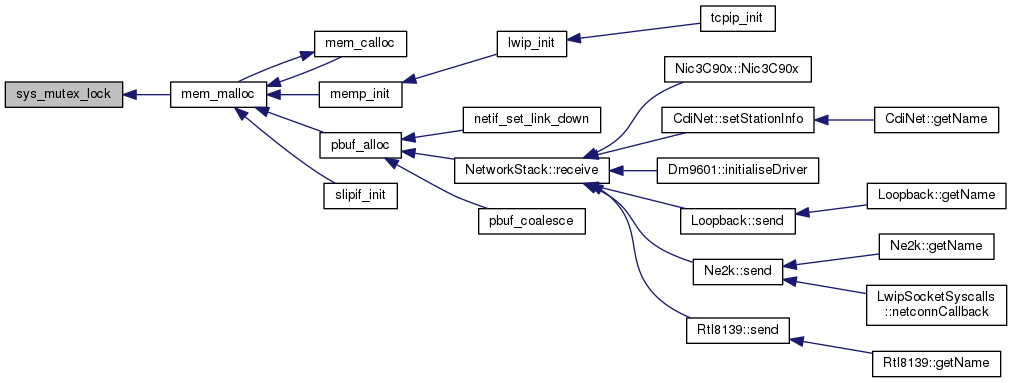
◆ sys_mutex_new()
| err_t sys_mutex_new | ( | sys_mutex_t * | mutex | ) |
Create a new mutex. Note that mutexes are expected to not be taken recursively by the lwIP code, so both implementation types (recursive or non-recursive) should work.
- Parameters
-
mutex pointer to the mutex to create
- Returns
- ERR_OK if successful, another err_t otherwise
Definition at line 338 of file sys_arch.cc.
References ERR_OK.
Referenced by mem_init(), and tcpip_init().
Here is the caller graph for this function:
◆ sys_mutex_set_invalid()
| void sys_mutex_set_invalid | ( | sys_mutex_t * | mutex | ) |
Set a mutex invalid so that sys_mutex_valid returns 0
Definition at line 365 of file sys_arch.cc.
Referenced by tcpip_shutdown().
Here is the caller graph for this function:
◆ sys_mutex_unlock()
| void sys_mutex_unlock | ( | sys_mutex_t * | mutex | ) |
Unlock a mutex
- Parameters
-
mutex the mutex to unlock
Definition at line 350 of file sys_arch.cc.
References Semaphore::release().
Referenced by mem_malloc().
Here is the caller graph for this function: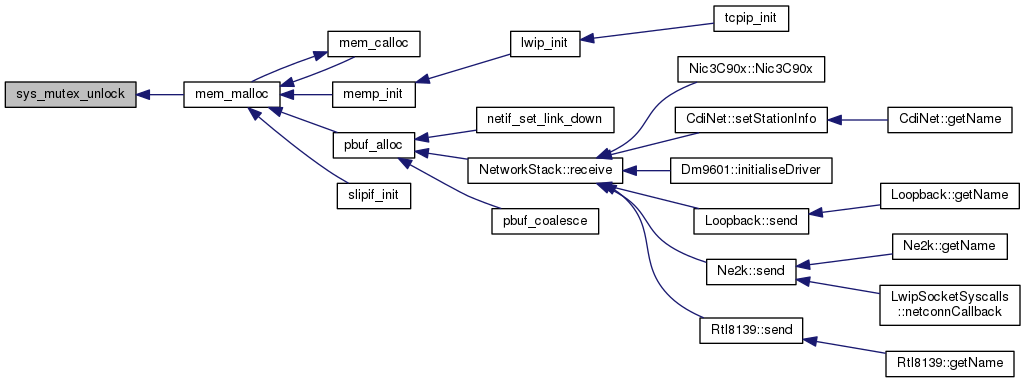
◆ sys_mutex_valid()
| int sys_mutex_valid | ( | sys_mutex_t * | mutex | ) |
Check if a mutex is valid/allocated: return 1 for valid, 0 for invalid
Definition at line 361 of file sys_arch.cc.
Referenced by tcpip_shutdown().
Here is the caller graph for this function: