#include <Display.h>
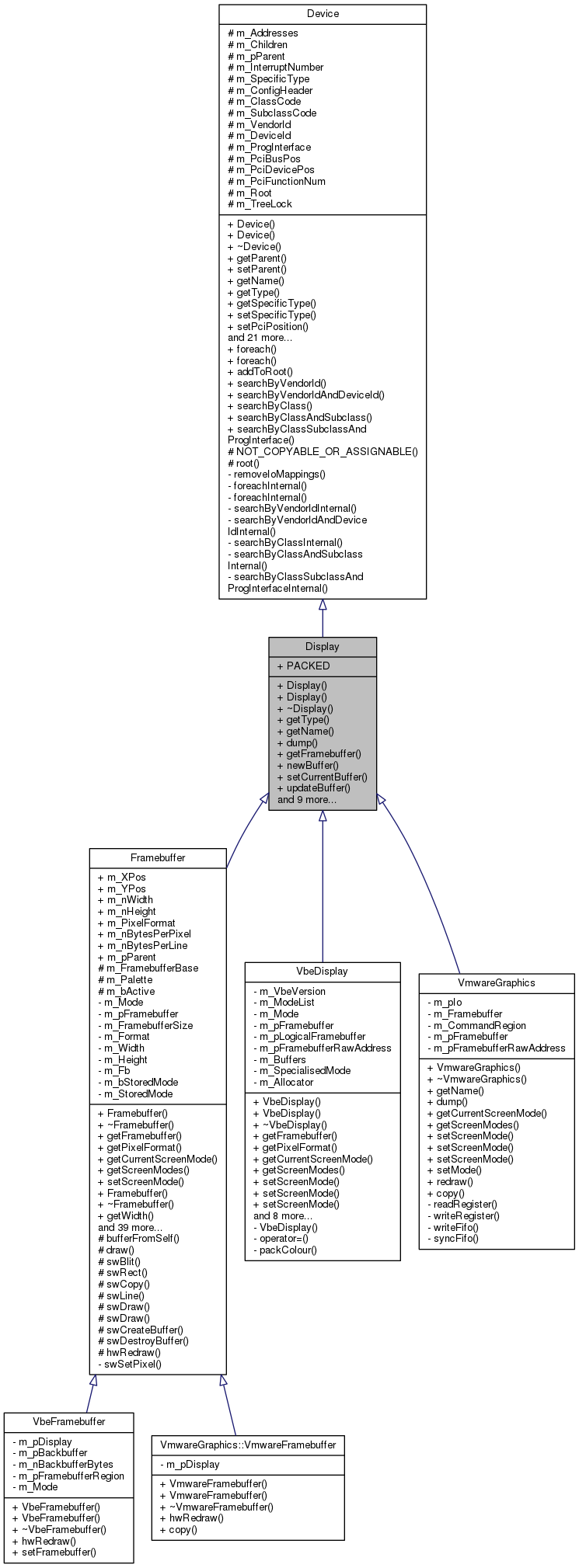
 Inheritance diagram for Display:
 Collaboration diagram for Display: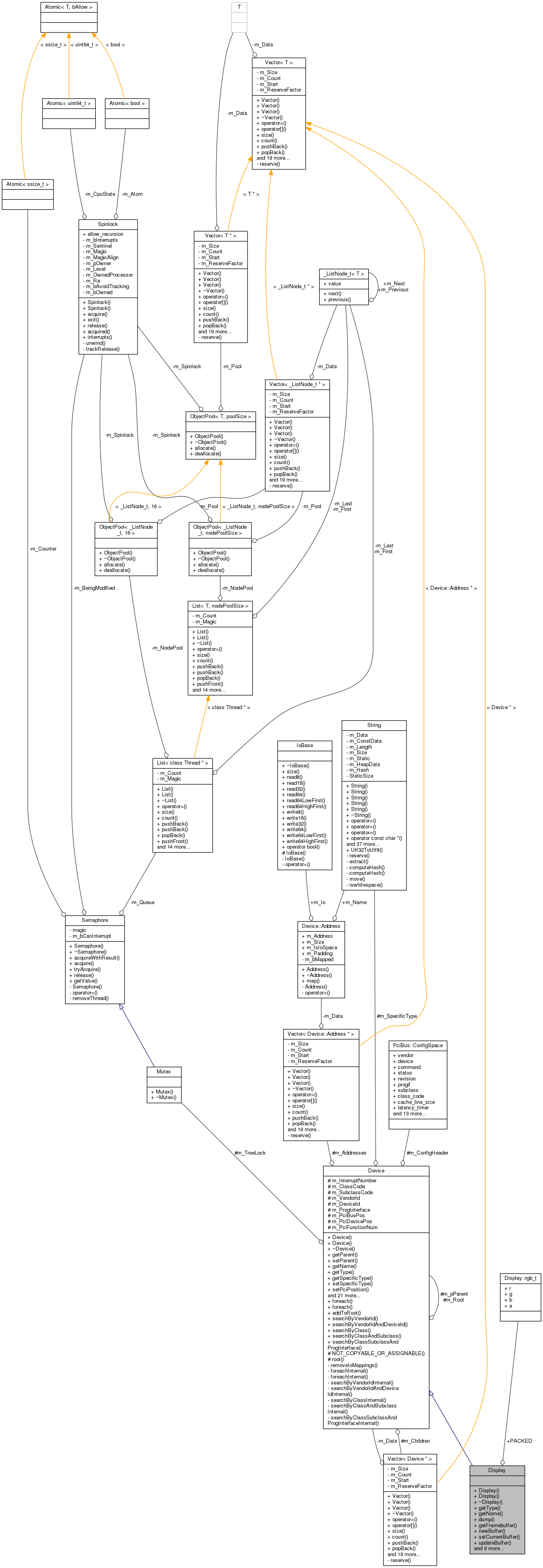
Classes | |
| struct | PixelFormat |
| struct | rgb_t |
| struct | ScreenMode |
Public Member Functions | |
| Display (Device *p) | |
| virtual Type | getType () |
| virtual void | getName (String &str) |
| virtual void | dump (String &str) |
| virtual void * | getFramebuffer () |
| virtual rgb_t * | newBuffer () |
| virtual void | setCurrentBuffer (rgb_t *pBuffer) |
| virtual void | updateBuffer (rgb_t *pBuffer, size_t x1=~0UL, size_t y1=~0UL, size_t x2=~0UL, size_t y2=~0UL) |
| virtual void | killBuffer (rgb_t *pBuffer) |
| virtual void | bitBlit (rgb_t *pBuffer, size_t fromX, size_t fromY, size_t toX, size_t toY, size_t width, size_t height) |
| virtual void | fillRectangle (rgb_t *pBuffer, size_t x, size_t y, size_t width, size_t height, rgb_t colour) |
| virtual bool | getPixelFormat (PixelFormat &pf) |
| virtual bool | getCurrentScreenMode (ScreenMode &sm) |
| virtual bool | getScreenModes (List< ScreenMode * > &sms) |
| virtual bool | setScreenMode (ScreenMode sm) |
| virtual bool | setScreenMode (size_t modeId) |
| virtual bool | setScreenMode (size_t nWidth, size_t nHeight, size_t nBpp) |
| Public Member Functions inherited from Device | |
| Device (Device *p) | |
| Device * | getParent () const |
| void | setParent (Device *p) |
| virtual const String & | getSpecificType () |
| virtual void | setSpecificType (String str) |
| void | setPciPosition (uint32_t bus, uint32_t device, uint32_t func) |
| void | setPciIdentifiers (uint8_t classCode, uint8_t subclassCode, uint16_t vendorId, uint16_t deviceId, uint8_t progIf) |
| void | setPciConfigHeader (const PciBus::ConfigSpace &space) |
| PciBus::ConfigSpace | getPciConfigHeader () const |
| uint8_t | getPciClassCode () |
| uint8_t | getPciSubclassCode () |
| uint16_t | getPciVendorId () |
| uint16_t | getPciDeviceId () |
| uint8_t | getPciProgInterface () |
| uint32_t | getPciBusPosition () |
| uint32_t | getPciDevicePosition () |
| uint32_t | getPciFunctionNumber () |
| Device * | getPhysicalFunction () const |
| size_t | getVirtualFunctionIndex () const |
| void | setVirtualFunction (Device *physicalFunction, size_t index) |
| virtual Vector< Address * > & | addresses () |
| virtual uintptr_t | getInterruptNumber () |
| virtual void | setInterruptNumber (uintptr_t n) |
| void | addChild (Device *pDevice) |
| Device * | getChild (size_t n) |
| size_t | getNumChildren () |
| void | removeChild (size_t n) |
| void | removeChild (Device *d) |
| void | replaceChild (Device *src, Device *dest) |
Public Attributes | |
| struct Display::rgb_t | PACKED |
Additional Inherited Members | |
| Public Types inherited from Device | |
| enum | Type { Generic , Root , Disk , Bus , Display , Network , Sound , Console , Mouse , Controller , UsbController , UsbGeneric , UsbContainer } |
| typedef Device *(* | Callback) (Device *) |
| Static Public Member Functions inherited from Device | |
| static bool | treeLockHeldByCurrentThread () |
| static void | foreach (Callback callback, Device *root=0) |
| template<class F , class... Args> | |
| static void | foreach (pedigree_std::Callable< F > &callback, Device *root, Args... args) |
| static void | addToRoot (Device *device) |
| static void | searchByVendorId (uint16_t vendorId, void(*callback)(Device *), Device *root=0) |
| static void | searchByVendorIdAndDeviceId (uint16_t vendorId, uint16_t deviceId, void(*callback)(Device *), Device *root=0) |
| static void | searchByClass (uint16_t classCode, void(*callback)(Device *), Device *root=0) |
| static void | searchByClassAndSubclass (uint16_t classCode, uint16_t subclassCode, void(*callback)(Device *), Device *root=0) |
| static void | searchByClassSubclassAndProgInterface (uint16_t classCode, uint16_t subclassCode, uint8_t progInterface, void(*callback)(Device *), Device *root=0) |
| Protected Member Functions inherited from Device | |
| NOT_COPYABLE_OR_ASSIGNABLE (Device) | |
| Static Protected Member Functions inherited from Device | |
| static Device & | root () |
| Protected Attributes inherited from Device | |
| Vector< Address * > | m_Addresses |
| Vector< Device * > | m_Children |
| Device * | m_pParent |
| Device * | m_PhysicalFunction |
| size_t | m_VirtualFunctionIndex |
| uintptr_t | m_InterruptNumber |
| String | m_SpecificType |
| PciBus::ConfigSpace | m_ConfigHeader |
| uint8_t | m_ClassCode |
| uint8_t | m_SubclassCode |
| uint16_t | m_VendorId |
| uint16_t | m_DeviceId |
| uint8_t | m_ProgInterface |
| uint32_t | m_PciBusPos |
| uint32_t | m_PciDevicePos |
| uint32_t | m_PciFunctionNum |
| Static Protected Attributes inherited from Device | |
| static Device | m_Root |
| static Mutex | m_TreeLock |
Detailed Description
A display is either a dumb framebuffer or something more accelerated.
The general use case for writing to the screen:
- Create a buffer with "newBuffer()".
- Set the buffer as the main on-screen buffer with "setCurrentBuffer()".
- Write to it, then update the changes to the screen with "updateBuffer()". Optionally here you can define a rectangle to be updated, usually referred to as a "dirty rectangle". * Optionally, you can use the faster acceleration functions "fillRectangle" and "bitBlit". Note that these functions may not actually be accelerated on-chip, this is up to the driver; however they are likely to be much faster than updating the buffer manually and calling updateBuffer().
Constructor & Destructor Documentation
◆ Display() [1/2]
| Display::Display | ( | ) |
Definition at line 38 of file Display.cc.
◆ Display() [2/2]
| Display::Display | ( | Device * | p | ) |
Definition at line 42 of file Display.cc.
◆ ~Display()
|
virtual |
Definition at line 44 of file Display.cc.
Member Function Documentation
◆ bitBlit()
|
virtual |
Blits data from [fromX,fromY] to [toX,toY], with the given width and height.
Definition at line 72 of file Display.cc.
◆ dump()
|
virtual |
Dumps a textual representation of the device into the given string.
Reimplemented from Device.
Reimplemented in VirtioGpu, and VmwareGraphics.
Definition at line 54 of file Display.cc.
◆ fillRectangle()
|
virtual |
Fills the rectangle from [x,y] extending by [width,height] with the given colour.
Definition at line 75 of file Display.cc.
◆ getCurrentScreenMode()
|
virtual |
Returns the current screen mode.
- Returns
- True if operation succeeded, false otherwise.
Reimplemented in VmwareGraphics, and VirtioGpu.
Definition at line 82 of file Display.cc.
Referenced by FramebufferFile::command().
Here is the caller graph for this function:
◆ getFramebuffer()
|
virtual |
Returns a pointer to a linear framebuffer. Returns 0 if none available.
- Warning
- Not intended to be used - use the buffer functions instead.
Reimplemented in VirtioGpu.
Definition at line 58 of file Display.cc.
◆ getName()
|
virtual |
Stores the device's name in str.
Reimplemented from Device.
Reimplemented in VirtioGpu, and VmwareGraphics.
Definition at line 50 of file Display.cc.
◆ getPixelFormat()
|
virtual |
Returns the format of each pixel in the framebuffer, along with the bits-per-pixel.
- Returns
- True if operation succeeded, false otherwise.
Reimplemented in VirtioGpu.
Definition at line 78 of file Display.cc.
◆ getScreenModes()
|
virtual |
Fills the given List with all of the available screen modes.
- Returns
- True if operation succeeded, false otherwise.
Reimplemented in VmwareGraphics, and VirtioGpu.
Definition at line 86 of file Display.cc.
Referenced by setScreenMode(), and setScreenMode().
Here is the caller graph for this function: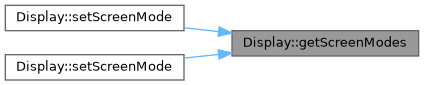
◆ getType()
|
virtual |
Returns the (abstract) type of the device.
Reimplemented from Device.
Definition at line 46 of file Display.cc.
References Device::Display.
◆ killBuffer()
|
virtual |
If a buffer is no longer being used, it can be deleted using this function.
Definition at line 70 of file Display.cc.
◆ newBuffer()
|
virtual |
Returns a new back buffer. This is the primary method for drawing to the screen. The buffer returned is in RGB 24-bit format and is the width and height of the screen.
Definition at line 62 of file Display.cc.
◆ setCurrentBuffer()
|
virtual |
Sets the currently viewed buffer to pBuffer.
Definition at line 66 of file Display.cc.
◆ setScreenMode() [1/3]
|
virtual |
Sets the current screen mode.
- Returns
- True if operation succeeded, false otherwise.
Reimplemented in VmwareGraphics, and VirtioGpu.
Definition at line 90 of file Display.cc.
Referenced by FramebufferFile::command(), panic(), VmwareGraphics::setScreenMode(), setScreenMode(), setScreenMode(), and Debugger::start().
Here is the caller graph for this function: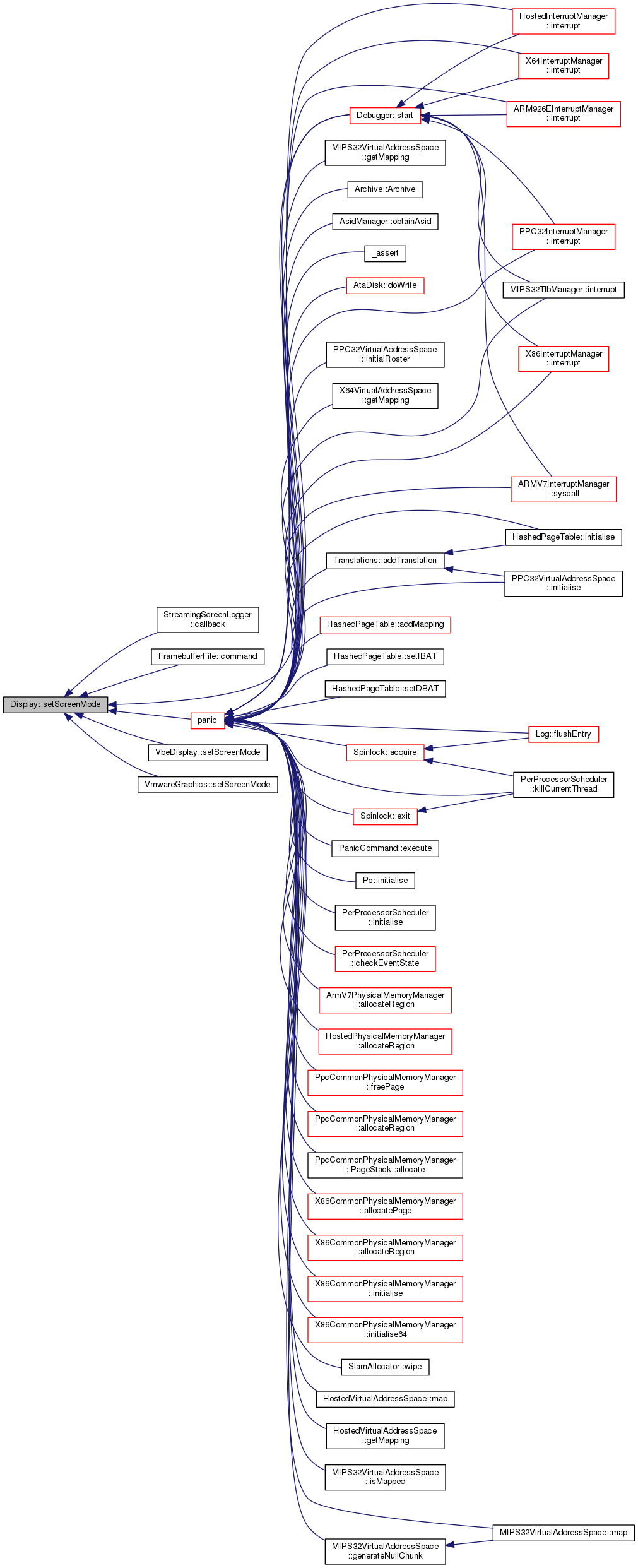
◆ setScreenMode() [2/3]
|
virtual |
Sets the current screen mode using a set of well-defined VBE IDs. Example: 0x117 = 1024x768x16.
Reimplemented in VmwareGraphics, and VirtioGpu.
Definition at line 94 of file Display.cc.
References List< T, nodePoolSize >::begin(), List< T, nodePoolSize >::end(), getScreenModes(), and setScreenMode().
◆ setScreenMode() [3/3]
|
virtual |
Sets the current screen mode using a width, height, and pixel depth
- Todo:
- "Closest match": allow a threshold for a match in case the specific mode specified cannot be set.
Reimplemented in VmwareGraphics, and VirtioGpu.
Definition at line 114 of file Display.cc.
References List< T, nodePoolSize >::begin(), Dec, List< T, nodePoolSize >::end(), getScreenModes(), Hex, and setScreenMode().
◆ updateBuffer()
|
virtual |
Updates the contents of pBuffer to the screen, or more specifically to video memory. If this buffer is not current (i.e. via a call to setCurrentBuffer) the screen content will obviously not change.
Optionally a rectangle can be provided - only this region will be updated.
Definition at line 68 of file Display.cc.
The documentation for this class was generated from the following files: