#include <Processor.h>
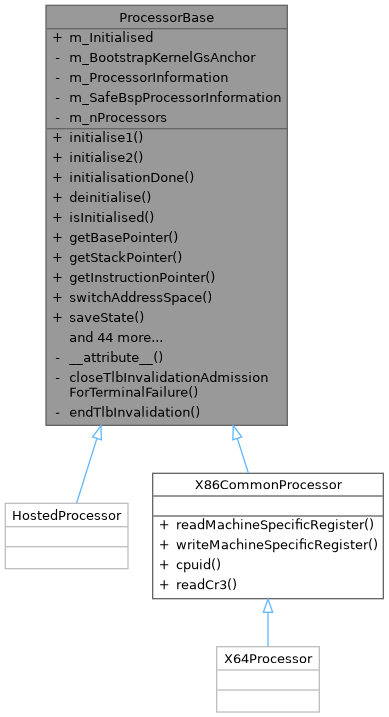
 Inheritance diagram for ProcessorBase:
 Collaboration diagram for ProcessorBase: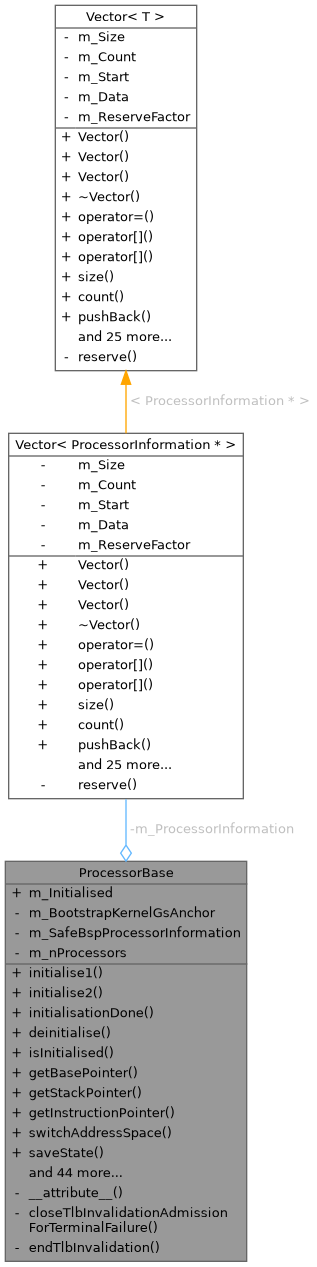
Static Public Member Functions | |
| static void | initialise1 (const BootstrapStruct_t &Info) INITIALISATION_ONLY |
| first stage in the initialisation of the processor-specific interface | |
| static void | initialise2 (const BootstrapStruct_t &Info) INITIALISATION_ONLY |
| second/last stage in the initialisation of the processor-specific interface | |
| static void | initialisationDone () |
| static void | deinitialise () |
| static size_t | isInitialised () |
| static uintptr_t | getBasePointer () |
| static uintptr_t | getStackPointer () |
| static uintptr_t | getInstructionPointer () |
| static void | switchAddressSpace (VirtualAddressSpace &AddressSpace) |
| static bool | saveState (SchedulerState &state) |
| static void | restoreState (SchedulerState &state, volatile uintptr_t *pLock=0) NORETURN |
| static void | restoreState (SyscallState &state, volatile uintptr_t *pLock=0) NORETURN |
| static void | contextSwitch (InterruptState *state) NORETURN |
| static void | switchState (bool bInterrupts, SchedulerState &a, SchedulerState &b, volatile uintptr_t *pLock=0) |
| static void | switchState (bool bInterrupts, SchedulerState &a, SyscallState &b, volatile uintptr_t *pLock=0) |
| static void | saveAndJumpKernel (bool bInterrupts, SchedulerState &s, volatile uintptr_t *pLock, uintptr_t address, uintptr_t stack, uintptr_t p1=0, uintptr_t p2=0, uintptr_t p3=0, uintptr_t p4=0) |
| static void | saveAndJumpUser (bool bInterrupts, SchedulerState &s, volatile uintptr_t *pLock, uintptr_t address, uintptr_t stack, uintptr_t p1=0, uintptr_t p2=0, uintptr_t p3=0, uintptr_t p4=0) |
| static void | jumpKernel (volatile uintptr_t *pLock, uintptr_t address, uintptr_t stack, uintptr_t p1=0, uintptr_t p2=0, uintptr_t p3=0, uintptr_t p4=0) NORETURN |
| static void | jumpUser (volatile uintptr_t *pLock, uintptr_t address, uintptr_t stack, uintptr_t p1=0, uintptr_t p2=0, uintptr_t p3=0, uintptr_t p4=0) NORETURN |
| static void | breakpoint () |
| static void | halt () |
| static void | reset () |
| static size_t | getDebugBreakpointCount () |
| static uintptr_t | getDebugBreakpoint (size_t nBpNumber, DebugFlags::FaultType &nFaultType, size_t &nLength, bool &bEnabled) |
| static void | enableDebugBreakpoint (size_t nBpNumber, uintptr_t nLinearAddress, DebugFlags::FaultType nFaultType, size_t nLength) |
| static void | disableDebugBreakpoint (size_t nBpNumber) |
| static uintptr_t | getDebugStatus () |
| static void | haltUntilInterrupt () |
| static void | pause () |
| static void | setInterrupts (bool bEnable) |
| static bool | getInterrupts () |
| static bool | inDeviceHardIrq () |
| static ExecutionContext | executionContext () |
| static bool | guardDeviceHardIrqOperation (DeviceHardIrqOperation operation) |
| static void | setSingleStep (bool bEnable, InterruptState &state) |
| static void | invalidate (void *pAddress) |
| static MUST_USE_RESULT TlbInvalidationResult | beginTlbInvalidation (TlbInvalidationGuard &guard) |
| static MUST_USE_RESULT TlbInvalidationResult | invalidateAll (void *pAddress) |
| static MUST_USE_RESULT TlbInvalidationResult | invalidateAll (void *pAddress, TlbInvalidationGuard &guard) |
| static MUST_USE_RESULT TlbInvalidationResult | invalidateProcessors (void *pAddress, TlbInvalidationGuard &guard, uint64_t processors) |
| static bool | tlbInvalidationFailureActive () |
| static bool | tlbInvalidationTerminal () |
| static void | invalidateICache (uintptr_t nAddr) |
| static void | invalidateDCache (uintptr_t nAddr) |
| static void | flushDCache (uintptr_t nAddr) |
| static void | flushDCacheAndInvalidateICache (uintptr_t startAddr, uintptr_t endAddr) |
| static void | identify (HugeStaticString &str) |
| static ProcessorId | id () |
| static size_t | index () |
| static ProcessorInformation & | information () |
| static ProcessorInformation * | informationAt (size_t cpu) |
| static size_t | getCount () |
| static void | setTlsBase (uintptr_t newBase) |
| static uintptr_t | getUserGsBase () |
| static void | setUserGsBase (uintptr_t newBase) |
Static Public Attributes | |
| static size_t | m_Initialised = 0 |
Static Private Member Functions | |
| static NEVER_INLINE | __attribute__ ((cold)) bool rejectDeviceHardIrqOperation(DeviceHardIrqOperation operation) |
| static MUST_USE_RESULT bool | closeTlbInvalidationAdmissionForTerminalFailure (TlbInvalidationGuard &guard, TlbInvalidationResult result) |
| static void | endTlbInvalidation (TlbInvalidationGuard &guard) |
Static Private Attributes | |
| static ProcessorInformation::KernelGsAnchor | m_BootstrapKernelGsAnchor |
| static Vector< ProcessorInformation * > | m_ProcessorInformation |
| static ProcessorInformation | m_SafeBspProcessorInformation |
| static size_t | m_nProcessors = 1 |
Friends | |
| class | Multiprocessor |
| class | TlbInvalidationGuard |
| class | X86GdtManager |
| class | X64GdtManager |
| class | Scheduler |
Detailed Description
Interface to the processor's capabilities
Architecture-specific implementations exist, and subclasses are used to add processor-specific methods (don't use the preprocessor for that anymore).
Cast a Processor object to the architecture-specific variant if you need to access architecturally unique features.
- Note
- static in member function declarations denotes that these functions return/process data on the processor that is executing this code.
Definition at line 129 of file Processor.h.
Member Function Documentation
◆ beginTlbInvalidation()
|
static |
Admit a page-table mutation before its first PTE write.
The guard may cover more than one address and must remain alive through every corresponding invalidateAll call. This operation uses bounded polling and rejects hard-IRQ, scheduler-IRQ, synthetic-IRQ, and debugger contexts before the mapping can change. The guarded region must not sleep or wait for work which itself needs new mapping admission.
Definition at line 227 of file arm64/Processor.cc.
References executionContext().
Referenced by invalidateAll().
Here is the caller graph for this function:
◆ breakpoint()
|
static |
Trigger a breakpoint
Definition at line 163 of file arm64/Processor.cc.
Referenced by _assert(), and Log::addEntry().
Here is the caller graph for this function:
◆ closeTlbInvalidationAdmissionForTerminalFailure()
|
staticprivate |
Escalate an admitted mutation to terminal failure.
Definition at line 243 of file arm64/Processor.cc.
Referenced by TlbInvalidationGuard::closeAdmissionForTerminalFailure().
Here is the caller graph for this function:
◆ contextSwitch()
|
static |
Restores a complete x64 interrupt frame through iretq.
The pointed-to state must remain valid and contain a fully validated return context. This is declared for future signal-return plumbing.
Referenced by X64SyscallManager::syscall().
Here is the caller graph for this function:
◆ deinitialise()
|
static |
Prepare the processor for reset by deinitialising things initialised in initialise2/initialise1.
Definition at line 45 of file arm64/Processor.cc.
◆ disableDebugBreakpoint()
|
static |
Disable a specific breakpoint
- Parameters
-
[in] nBpNumber the breakpoint number [0 - (getDebugBreakpointCount() - 1)]
Definition at line 204 of file arm64/Processor.cc.
Referenced by BreakpointCommand::execute().
Here is the caller graph for this function:
◆ enableDebugBreakpoint()
|
static |
Enable a specific breakpoint
- Parameters
-
[in] nBpNumber the breakpoint number [0 - (getDebugBreakpointCount() - 1)]
[in] nLinearAddress the linear Adress that should trigger a breakpoint exception [in] nFaultType the type of access that should trigger a breakpoint exception [in] nLength the size/length of the breakpoint
Definition at line 203 of file arm64/Processor.cc.
Referenced by BreakpointCommand::execute().
Here is the caller graph for this function:
◆ endTlbInvalidation()
|
staticprivate |
Release an active page-table mutation admission lease.
Definition at line 238 of file arm64/Processor.cc.
Referenced by TlbInvalidationGuard::retire().
Here is the caller graph for this function:
◆ executionContext()
|
static |
Classifies the current execution boundary without relying on a per-processor IRQ marker that could survive a Thread context switch.
Definition at line 109 of file Processor.cc.
References Thread::executionContext(), getInterrupts(), and information().
Referenced by beginTlbInvalidation(), SchedulerTimer::canRemoveHandlerInCurrentContext(), ThreadedIrqDispatcher::canShutdown(), ThreadedIrqDispatcher::prepareLine(), RequestQueue::publishAsyncRequest(), VFS::removeMountCallback(), VFS::removeProbeCallback(), PerProcessorScheduler::serviceProcessStopAtUserReturn(), Pic::unregisterHandler(), and VirtIrqManager::unregisterHandler().
Here is the caller graph for this function: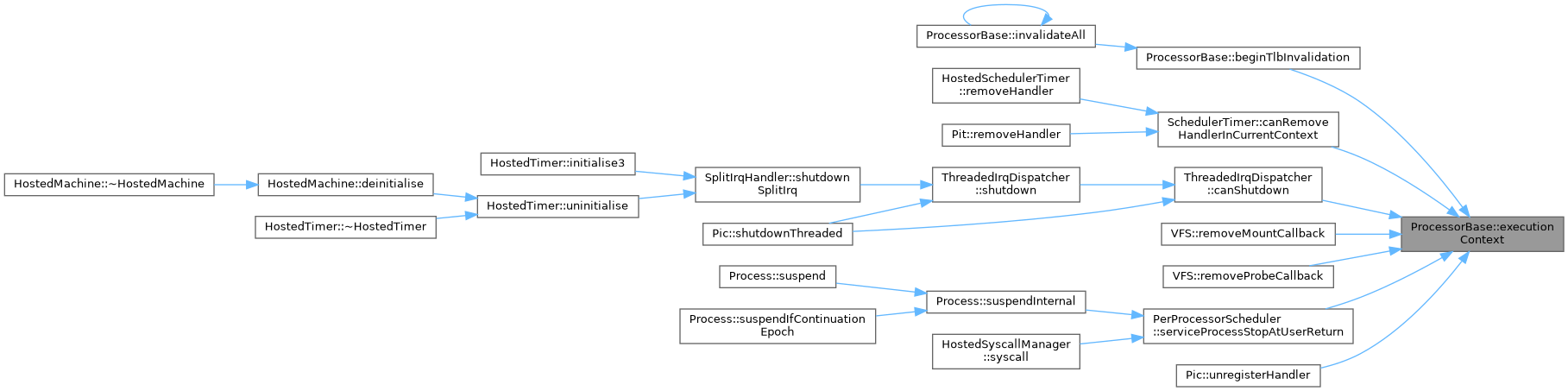
◆ flushDCache()
|
static |
Flush a line in the data cache.
- Parameters
-
[in] nAddr The address of a memory location to flush from the Dcache.
Definition at line 284 of file arm64/Processor.cc.
◆ flushDCacheAndInvalidateICache()
|
static |
Flush from the data cache and invalidate into the instruction cache. This must be used whenever code is written to memory and needs to be executed.
- Parameters
-
startAddr The first address to be flushed and invalidated. endAddr The last address to be flushed and invalidated.
Definition at line 288 of file arm64/Processor.cc.
Referenced by Elf::load().
Here is the caller graph for this function:
◆ getBasePointer()
|
static |
Get the base-pointer of the calling function
- Returns
- base-pointer of the calling function
Definition at line 129 of file arm64/Processor.cc.
Referenced by Backtrace::performBpBacktrace().
Here is the caller graph for this function:
◆ getCount()
|
static |
Get the number of CPUs currently available
Definition at line 314 of file arm64/Processor.cc.
Referenced by Spinlock::acquireContended(), CpuInfoCommand::execute(), informationAt(), Scheduler::initialise(), and PerProcessorScheduler::initialise().
Here is the caller graph for this function: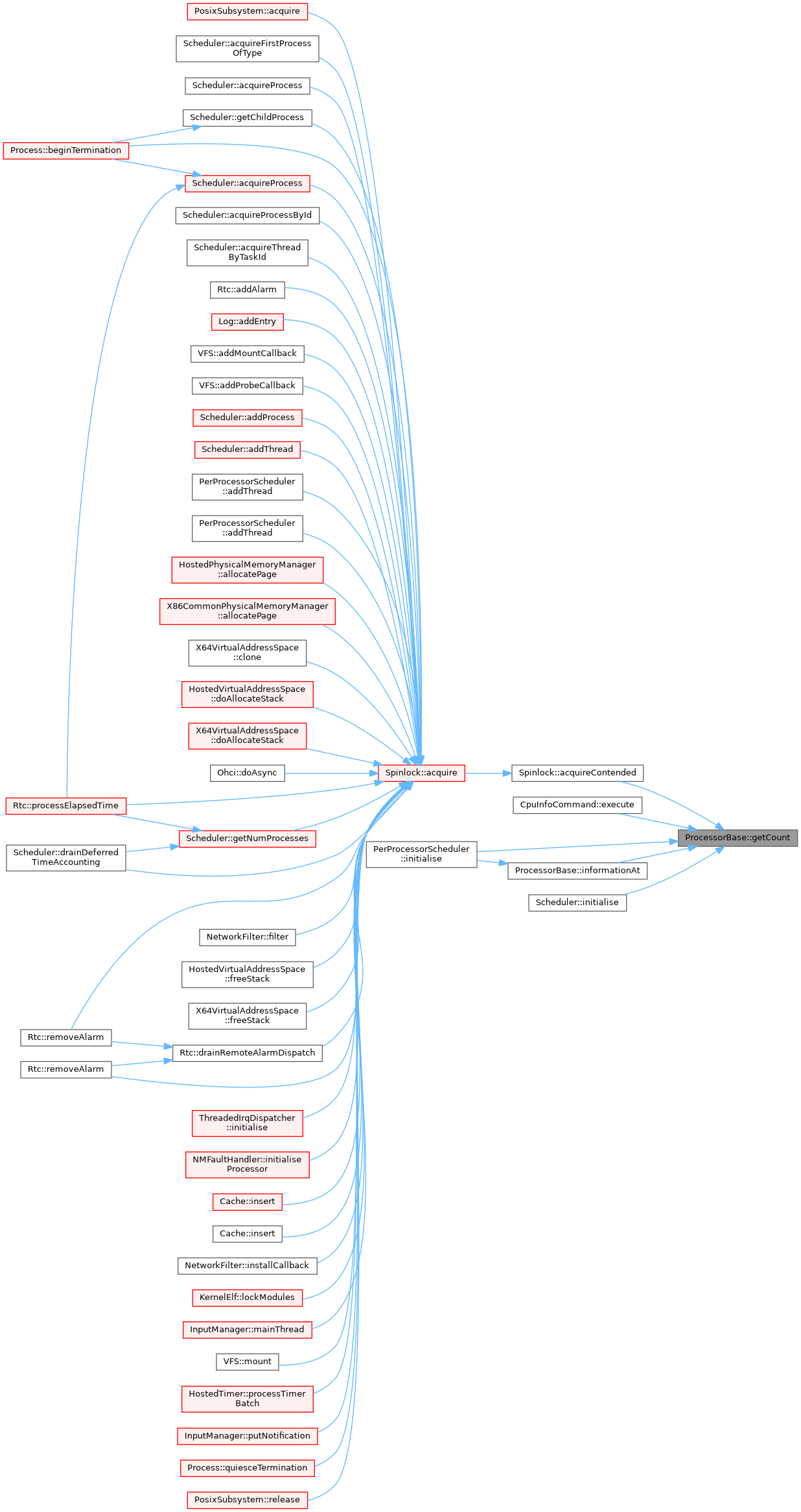
◆ getDebugBreakpoint()
|
static |
Get information for a specific breakpoint
- Parameters
-
[in] nBpNumber the breakpoint number [0 - (getDebugBreakpointCount() - 1)]
[in,out] nFaultType the breakpoint type [in,out] nLength the breakpoint size/length [in,out] bEnabled is the breakpoint enabled?
Definition at line 195 of file arm64/Processor.cc.
Referenced by BreakpointCommand::execute().
Here is the caller graph for this function:
◆ getDebugBreakpointCount()
|
static |
Return the (total) number of breakpoints
- Returns
- (total) number of breakpoints
Definition at line 191 of file arm64/Processor.cc.
Referenced by BreakpointCommand::execute().
Here is the caller graph for this function:
◆ getDebugStatus()
|
static |
Get the debug status
- Todo:
- is the debug status somehow abtractable?
- Returns
- the debug status
Definition at line 205 of file arm64/Processor.cc.
◆ getInstructionPointer()
|
static |
Get the instruction-pointer of the calling function
- Returns
- instruction-pointer of the calling function
Definition at line 141 of file arm64/Processor.cc.
Referenced by Backtrace::performBpBacktrace().
Here is the caller graph for this function:
◆ getInterrupts()
|
static |
Get the IRQ state
- Returns
- true, if interrupt requests are enabled, false otherwise
Definition at line 157 of file arm64/Processor.cc.
Referenced by Spinlock::acquire(), PerProcessorScheduler::addThread(), PerProcessorScheduler::addThread(), RequestQueue::canWaitForCompletion(), PerProcessorScheduler::checkEventState(), MemoryPressureManager::compact(), VmwareGraphics::VmwareFramebuffer::copy(), IrqHandlerRegistry::dispatchThreaded(), X64VirtualAddressSpace::doAllocateStack(), AtaDisk::doRead(), Rtc::drainRemoteAlarmDispatch(), executionContext(), PosixSubsystem::exit(), Thread::TemporarySignalMask::finish(), VmwareGraphics::getCurrentScreenMode(), VmwareGraphics::getScreenModes(), Rtc::getTickCountNano(), haltUntilInterrupt(), VmwareGraphics::VmwareFramebuffer::hwRedraw(), Rtc::initialise2(), Rtc::initialiseProcessorClock(), Thread::popState(), RequestQueue::publishAsyncRequest(), Thread::pushState(), VirtIrqManager::registerHardIsaIrqHandler(), VirtIrqManager::registerSchedulerIrqHandler(), Process::releaseVforkAddressSpace(), Log::removeCallback(), MemoryPressureManager::removeHandler(), PosixSubsystem::resolveUserPageFault(), NMFaultHandler::restoreCurrentThreadFpuState(), Thread::retainTemporarySignalWaitInterruptionOrClear(), NMFaultHandler::saveCurrentThreadFpuState(), PerProcessorScheduler::schedule(), GraphicsService::serve(), PerProcessorScheduler::serviceDeferredSubsystemException(), PerProcessorScheduler::serviceProcessStopAtUserReturn(), PerProcessorScheduler::setClockDeadline(), VmwareGraphics::setScreenMode(), VmwareGraphics::setScreenMode(), VmwareGraphics::setScreenMode(), SplitIrqHandler::shutdownSplitIrq(), HostedInterruptManager::signalShim(), ServiceManager::tryGetService(), Spinlock::unlock(), VirtIrqManager::unregisterHandler(), PageFaultHandler::unregisterHandler(), TimerHandlerRegistry::unregisterHandler(), IrqHandlerRegistry::unregisterHandler(), VirtIrqManager::unregisterSchedulerIrqHandler(), AtaDisk::writePageBuffer(), and Process::~Process().
◆ getStackPointer()
|
static |
Get the stack-pointer of the calling function
- Returns
- stack-pointer of the calling function
Definition at line 135 of file arm64/Processor.cc.
Referenced by jumpUser().
Here is the caller graph for this function:
◆ getUserGsBase()
|
static |
Definition at line 224 of file x64/Processor.cc.
◆ guardDeviceHardIrqOperation()
|
inlinestatic |
Enforces the device hard-IRQ execution boundary.
Returns true outside device hard-IRQ callbacks. A violation is fatal in production; hosted smoke tests may install a hook which converts the violation into a false return so the rejecting call site can be tested.
Definition at line 585 of file Processor.h.
References inDeviceHardIrq(), and LIKELY.
Referenced by Semaphore::acquireForCompletion(), SlamAllocator::allocate(), Semaphore::release(), PerProcessorScheduler::schedule(), and WaitQueue::wakeAllIfWaiting().
Here is the caller graph for this function: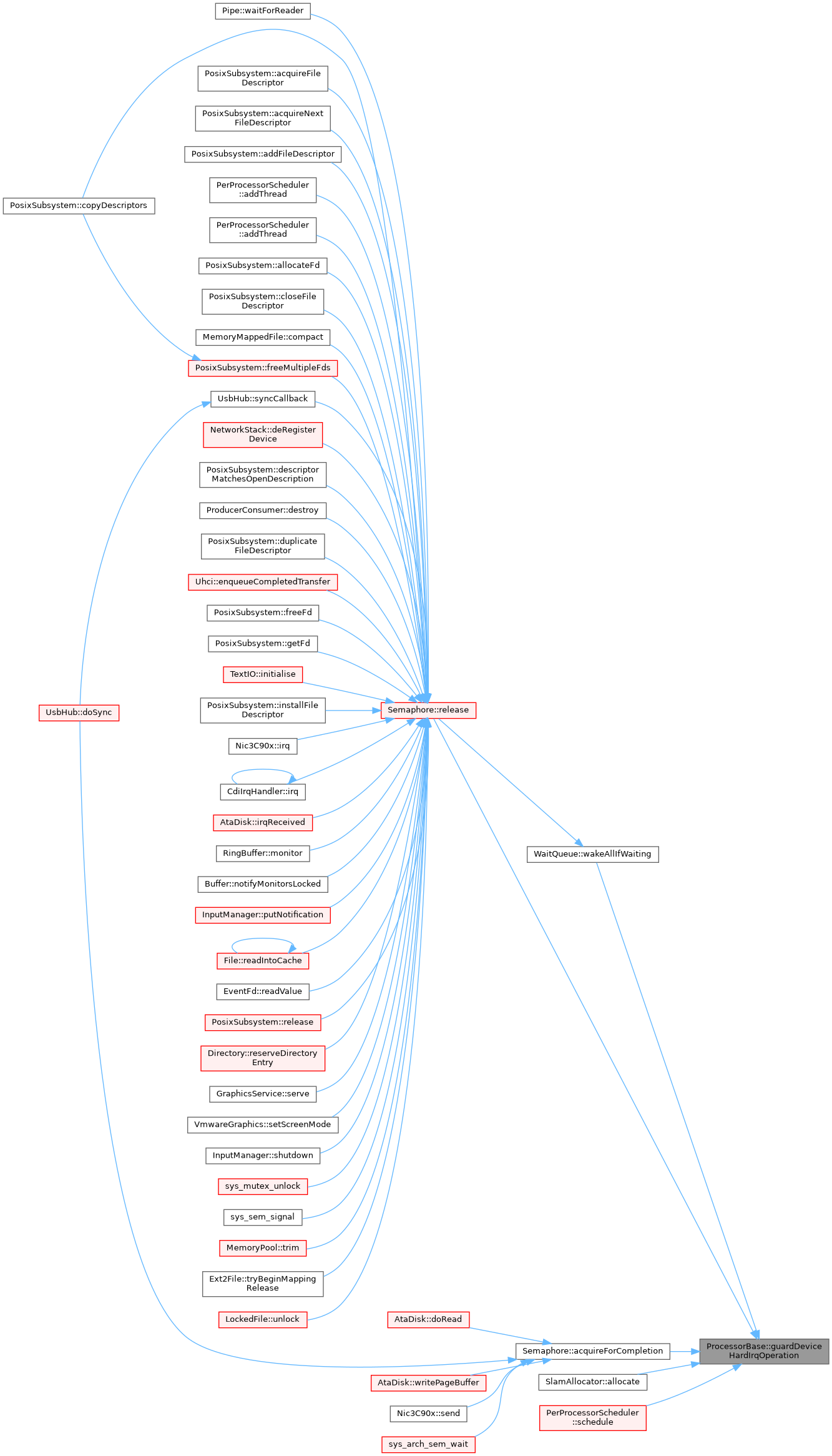
◆ halt()
|
static |
Halt this processor
Definition at line 167 of file arm64/Processor.cc.
Referenced by IoPortManager::allocate(), IoPortManager::free(), panic(), MemoryMappedIo::read16(), MemoryMappedIo::read32(), IoPort::read64(), MemoryMappedIo::read64(), MemoryMappedIo::read8(), reset(), Debugger::start(), MemoryMappedIo::write16(), MemoryMappedIo::write32(), IoPort::write64(), MemoryMappedIo::write64(), and MemoryMappedIo::write8().
Here is the caller graph for this function: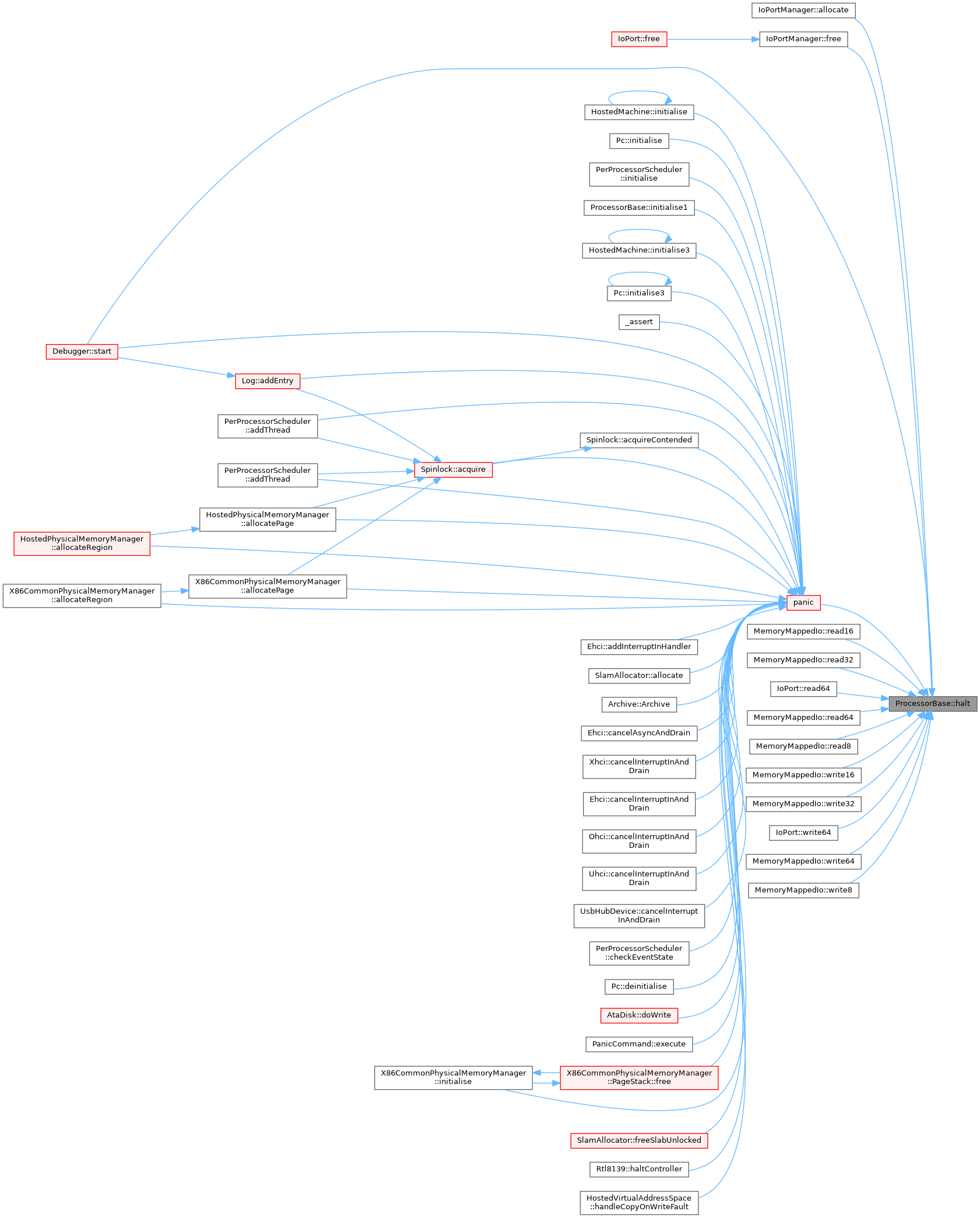
◆ haltUntilInterrupt()
|
static |
Wait for an IRQ to fire. Possible HALT or low-power state.
Definition at line 171 of file arm64/Processor.cc.
References getInterrupts(), and setInterrupts().
Referenced by PerProcessorScheduler::idleUntilInterrupt().
Here is the caller graph for this function:
◆ id()
|
static |
Get the ProcessorId of this processor
- Returns
- the ProcessorId of this processor
Definition at line 311 of file arm64/Processor.cc.
References information().
Referenced by PerProcessorScheduler::addThread(), PerProcessorScheduler::addThread(), PerProcessorScheduler::initialise(), X64InterruptManager::interrupt(), HostedSchedulerTimer::registerHandler(), VirtSchedulerTimer::registerHandler(), HostedSchedulerTimer::removeHandler(), VirtSchedulerTimer::removeHandler(), and PosixSubsystem::threadException().
Here is the caller graph for this function: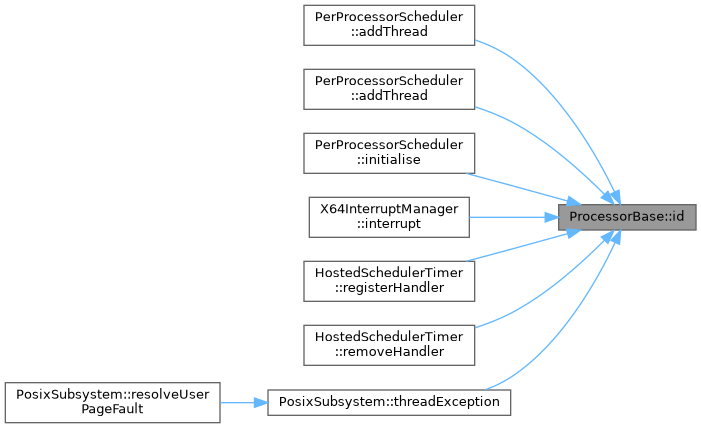
◆ identify()
|
static |
Populate 'str' with a string describing the characteristics of this processor.
Definition at line 303 of file arm64/Processor.cc.
Referenced by CpuInfoCommand::execute().
Here is the caller graph for this function:
◆ inDeviceHardIrq()
|
inlinestatic |
True only while an explicit device hard-IRQ callback is running.
Definition at line 581 of file Processor.h.
References information().
Referenced by PosixSubsystem::exit(), guardDeviceHardIrqOperation(), NetworkStack::receive(), NetworkStack::receive(), PerProcessorScheduler::serviceProcessStopAtUserReturn(), sys_mbox_trypost(), TimerFdService::timer(), and Mailbox< T, preallocatedSize, Notifications >::tryWrite().
Here is the caller graph for this function: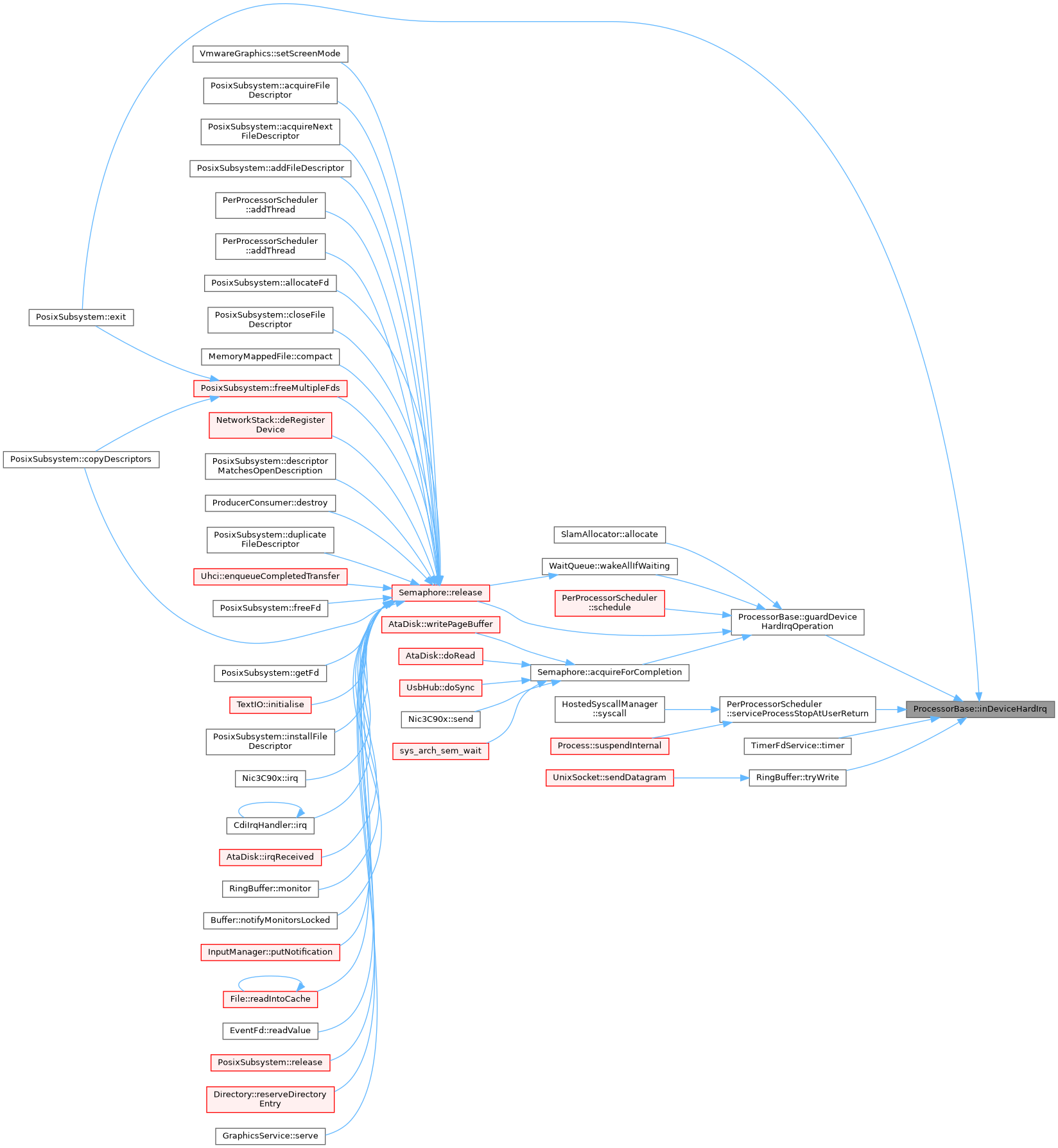
◆ index()
|
inlinestatic |
Get this processor's dense topology index for per-CPU storage. The bootstrap processor owns slot zero before discovery; each additional processor receives its permanent slot before it enters C++.
Definition at line 36 of file x64/Processor.h.
References index().
Referenced by Spinlock::acquire(), Spinlock::acquireContended(), Scheduler::addThread(), LocksCommand::checkSchedule(), LocksCommand::checkState(), index(), Pic::initialise(), ThreadedIrqDispatcher::initialise(), PerProcessorScheduler::initialise(), Pic::initialiseThreaded(), Pic::interrupt(), LocksCommand::lockReleased(), X86CommonProcessor::readMachineSpecificRegister(), Timer::sampleCpuTime(), Rtc::sampleCpuTime(), Pic::shutdownThreaded(), Debugger::start(), and X86CommonProcessor::writeMachineSpecificRegister().
Here is the caller graph for this function: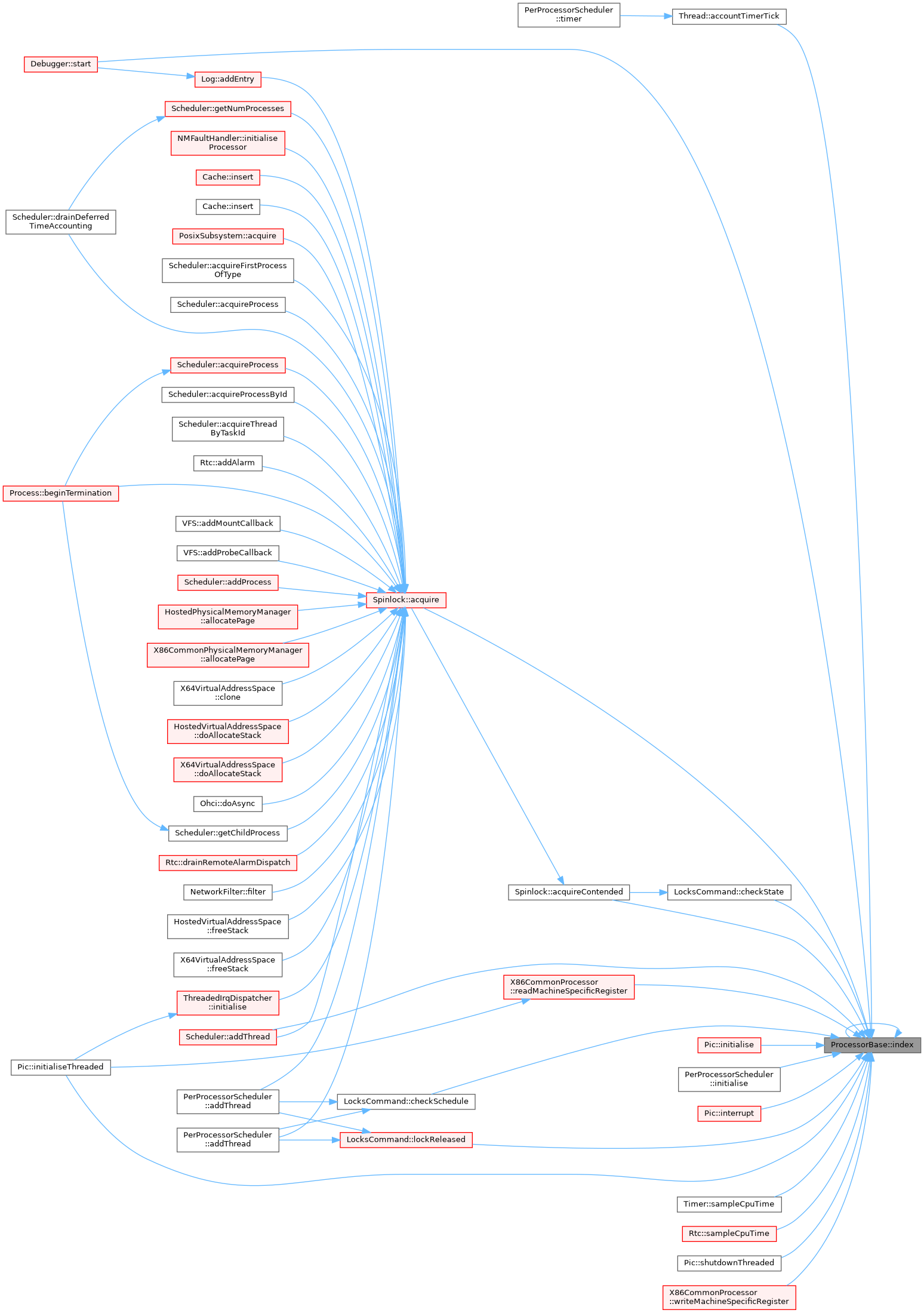
◆ information()
|
inlinestatic |
Get the ProcessorInformation structure of this processor
- Returns
- the ProcessorInformation structure of this processor
Definition at line 30 of file x64/Processor.h.
References information().
Referenced by PerProcessorScheduler::abandonCurrentThreadStack(), PosixSubsystem::acquire(), Spinlock::acquire(), Spinlock::acquireContended(), Semaphore::acquireForCompletion(), BusMasterIde::add(), HostedTimer::addAlarm(), Rtc::addAlarm(), VirtTimer::addAlarm(), RequestQueue::addRequest(), PerProcessorScheduler::addThread(), PerProcessorScheduler::addThread(), Ohci::addTransferToTransaction(), Uhci::addTransferToTransaction(), SlamAllocator::allocate(), Elf::allocate(), HostedPhysicalMemoryManager::allocateRegion(), X86CommonPhysicalMemoryManager::allocateRegion(), MemoryMapManager::allows(), Cache::beginMutableLoan(), Process::beginTermination(), UnixSocketSyscalls::bind(), SchedulerTimer::canRemoveHandlerInCurrentContext(), ThreadedIrqDispatcher::canShutdown(), RequestQueue::canWaitForCompletion(), PosixSubsystem::checkAddress(), PerProcessorScheduler::checkEventState(), HostedVirtualAddressSpace::clone(), MemoryMapManager::clone(), RandomFile::command(), X64PreparedPageRemap::commit(), PerProcessorScheduler::commitCurrentThreadExit(), PerProcessorScheduler::commitUserReturnTerminalState(), MemoryMapManager::compact(), MemoryPressureManager::compact(), MemoryMappedFile::compact(), Thread::completeAffinityAtSafePoint(), MemoryMapManager::contains(), Pipe::decreaseRefCount(), LinuxAmd64Signal::AsyncEvent::deliverAtUserReturn(), LinuxAmd64Signal::AsyncEvent::deliverAtUserReturn(), X64VirtualAddressSpace::detachEmptyTables(), HostedVirtualAddressSpace::detachMapping(), Thread::discardUserStackMetadataForExec(), IrqHandlerRegistry::dispatchThreaded(), RequestQueue::drain(), Rtc::drainRemoteAlarmDispatch(), PerProcessorScheduler::eventHandlerReturned(), Cache::evict(), MappingCommand::execute(), executionContext(), PosixSubsystem::exit(), NetworkFilter::filter(), Elf::finaliseModule(), MemoryMapManager::findAttachment(), Cache::finishRetirement(), File::getPhysicalPage(), Rtc::getTickCountNano(), id(), inDeviceHardIrq(), information(), UserManager::initialise(), InputManager::initialise(), CacheManager::initialise(), ThreadedIrqDispatcher::initialise(), Scheduler::initialise(), X64GdtManager::initialise(), PerProcessorScheduler::initialise(), Rtc::initialise2(), Dm9601::initialiseDriver(), X64GdtManager::initialiseProcessor(), Rtc::initialiseProcessorClock(), DynamicLinker::initPlt(), HostedInterruptManager::interrupt(), X64InterruptManager::interrupt(), NMFaultHandler::interrupt(), PageFaultHandler::interrupt(), X64VirtualAddressSpace::invalidateMapping(), IrqHandlerRegistry::invalidateThreadedLine(), PosixSubsystem::invoke(), ThreadedIrqDispatcher::isCurrentWorker(), Thread::joinInternal(), jumpUser(), Process::kill(), PosixSubsystem::kill(), PosixSubsystem::loadElf(), Elf::loadModule(), ConsoleManager::lockConsole(), User::login(), Cache::lookupStable(), InputManager::mainThread(), Cache::map(), VFS::mount(), Ne2k::Ne2k(), Backtrace::performBpBacktrace(), PosixSubsystem::prepareExecutable(), Process::prepareThreadExit(), File::publishEvent(), PosixSubsystem::queueSignalDelivery(), Process::quiesceTermination(), Process::releaseVforkAddressSpace(), Pipe::releaseVfsReference(), AnonymousMemoryMap::remove(), MemoryMappedFile::remove(), MemoryMapManager::removeAndRelease(), MemoryMapManager::removeAttachment(), Log::removeCallback(), NetworkFilter::removeCallback(), MemoryPressureManager::removeHandler(), VFS::removeMountCallback(), VFS::removeProbeCallback(), VirtualTerminalManager::reportPermission(), PerProcessorScheduler::requestCurrentThreadExitToIdle(), Scheduler::requestLoadAverageSample(), DynamicLinker::resolvePlt(), PosixSubsystem::resolveUserPageFault(), NMFaultHandler::restoreCurrentThreadFpuState(), DeviceHardIrqContext::restoreDepth(), restoreState(), Cache::retireWriteback(), X64InterruptManager::returnFromInterrupt(), pocketknife::runConcurrentlyAttached(), Rtc::sampleCpuTime(), Scheduler::sampleLoadAverage(), NMFaultHandler::saveCurrentThreadFpuState(), PerProcessorScheduler::schedule(), PosixSubsystem::sendSignal(), SignalEvent::serialize(), PerProcessorScheduler::serviceDeferredSubsystemException(), PerProcessorScheduler::serviceIrqWorkDoorbell(), PerProcessorScheduler::servicePendingScheduling(), PerProcessorScheduler::serviceProcessStopAtUserReturn(), PerProcessorScheduler::serviceUserReturnWork(), PerProcessorScheduler::serviceUserReturnWork(), PerProcessorScheduler::setClockDeadline(), Thread::setKernelStack(), AnonymousMemoryMap::setPermissions(), MemoryMappedFile::setPermissions(), Process::setTimeAccountingReportInterest(), Thread::setTlsBase(), ThreadedIrqDispatcher::shutdown(), SplitIrqHandler::shutdownSplitIrq(), HostedInterruptManager::signalShim(), Debugger::start(), Process::suspendInternal(), switchAddressSpace(), Cache::syncAll(), sys_thread_is_current(), HostedSyscallManager::syscall(), X64SyscallManager::syscall(), Thread::Thread(), Thread::Thread(), Thread::threadExited(), PerProcessorScheduler::timer(), DLTrapHandler::trap(), MemoryMappedFile::trap(), ConsoleManager::unlockConsole(), MemoryMapManager::unmap(), MemoryMapManager::unmapAllUnlocked(), PageFaultHandler::unregisterHandler(), TimerHandlerRegistry::unregisterHandler(), IrqHandlerRegistry::unregisterHandler(), ConditionVariable::wait(), Event::waitForDeliveries(), Process::waitUntilTerminationReapable(), Process::waitUntilTerminationReapableForTerminalCoordinator(), RequestQueue::work(), Cache::PreparedDiscard::writeback(), Cache::writebackPage(), Scheduler::yield(), NetworkFilter::~NetworkFilter(), PosixSubsystem::~PosixSubsystem(), and Process::~Process().
◆ informationAt()
|
static |
Resolves a discovered logical slot, including before BSP identity is live.
Definition at line 39 of file Processor.cc.
References Vector< T >::count(), getCount(), m_ProcessorInformation, and m_SafeBspProcessorInformation.
Referenced by PerProcessorScheduler::initialise(), and PerProcessorScheduler::setClockDeadline().
Here is the caller graph for this function:
◆ initialisationDone()
|
static |
End of the kernel core initialisation reached, the initialisation functions and data may now get unmapped/freed.
Definition at line 41 of file arm64/Processor.cc.
◆ initialise1()
|
static |
first stage in the initialisation of the processor-specific interface
Initialises the processor specific interface. After this function call the whole processor-specific interface is initialised. Note though, that only the bootstrap processor is started. Multiprocessor/-core facilities are available after initialiseProcessor2().
- Note
- This function should only be called once and by main()
- Parameters
-
[in] Info reference to the multiboot information structure
todo move to a better place
Definition at line 28 of file arm64/Processor.cc.
References PageFaultHandler::initialise(), PageFaultHandler::instance(), m_Initialised, and m_SafeBspProcessorInformation.
◆ initialise2()
|
static |
second/last stage in the initialisation of the processor-specific interface
Initialises the Multiprocessor/-core functionality of the processor-specific interface. This function may only be called after initialiseProcessor1 and after the whole machine specific interface has been initialised.
- Note
- This function should only be called once and by main()
Definition at line 36 of file arm64/Processor.cc.
References m_Initialised.
◆ invalidate()
|
static |
Invalidate the TLB entry containing a specific virtual address
- Parameters
-
[in] pAddress the specific virtual address
- Note
- This affects only the executing processor.
Definition at line 216 of file arm64/Processor.cc.
Referenced by Arm64VirtualAddressSpace::detachMapping(), Armv7VirtualAddressSpace::detachMapping(), invalidateAll(), invalidateProcessors(), Arm64VirtualAddressSpace::map(), Armv7VirtualAddressSpace::map(), Arm64VirtualAddressSpace::revertToKernelAddressSpace(), Armv7VirtualAddressSpace::revertToKernelAddressSpace(), Arm64VirtualAddressSpace::trySetFlags(), and Armv7VirtualAddressSpace::trySetFlags().
Here is the caller graph for this function:
◆ invalidateAll() [1/2]
|
static |
Invalidate one virtual address on every online processor and do not return until each processor has acknowledged the request.
The caller must keep the online-processor set, page-table mutation, and its page-table storage stable until this returns Success. The implementation is allocation-free and uses bounded polling, so it is valid in ordinary thread and atomic thread context. Explicit device, scheduler, synthetic-IRQ, and debugger contexts are rejected: none may wait for another processor's progress. On any failure, the caller must not reclaim or reuse the old mapping's backing storage. Convenience invalidation for callers which have not changed a PTE. Page-table writers must acquire a guard before their mutation and use the overload below, so processor retirement cannot overtake publication.
Definition at line 259 of file arm64/Processor.cc.
References beginTlbInvalidation(), and invalidateAll().
Referenced by invalidateAll().
Here is the caller graph for this function:
◆ invalidateAll() [2/2]
|
static |
Invalidate under an admission lease acquired before the PTE mutation.
Definition at line 265 of file arm64/Processor.cc.
References invalidate().
◆ invalidateDCache()
|
static |
Invalidate a line in the data cache.
- Parameters
-
[in] nAddr The address of a memory location to invalidate from the Dcache.
Definition at line 280 of file arm64/Processor.cc.
◆ invalidateICache()
|
static |
Invalidate a line in the instruction cache.
- Parameters
-
[in] nAddr The address of a memory location to invalidate from the Icache.
Definition at line 276 of file arm64/Processor.cc.
◆ invalidateProcessors()
|
static |
Invalidate locally and on the selected dense processor slots under a lease.
Definition at line 297 of file x86_common/Processor.cc.
References invalidate().
◆ isInitialised()
|
static |
Is the processor-specific interface initialised?
- Returns
- 0, if nothing has been initialised, 1, if initialise1() has been executed successfully, 2, if initialise2() has been executed successfully
Definition at line 105 of file Processor.cc.
References m_Initialised.
Referenced by IoPortManager::allocate(), and IoPortManager::free().
Here is the caller graph for this function: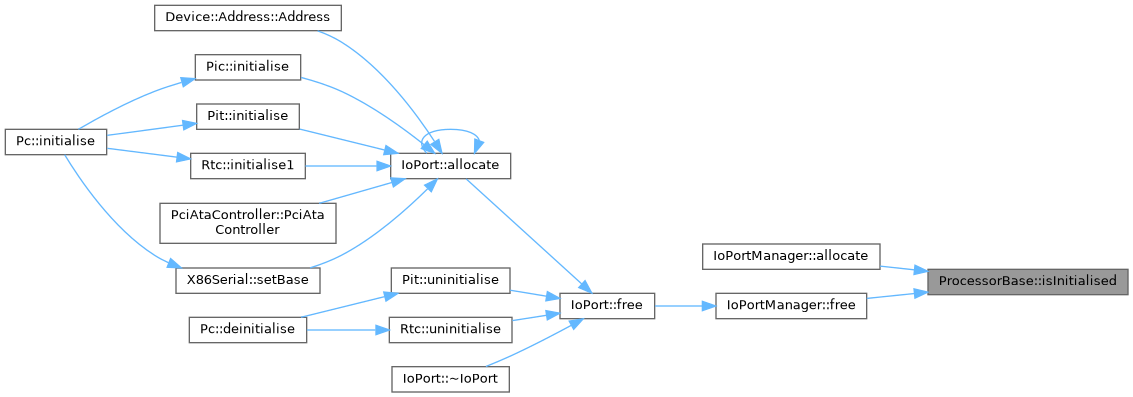
◆ jumpKernel()
|
static |
Jumps to an address, in kernel mode, and sets up a calling frame with the given parameters.
- Parameters
-
pLock Optional lock to release. address Address to jump to. stack Stack to use (set to 0 for current stack). param1 First parameter. param2 Second parameter. param3 Third parameter. param4 Fourth parameter.
Definition at line 115 of file arm64/Processor.cc.
Referenced by PerProcessorScheduler::addThread(), and saveAndJumpKernel().
Here is the caller graph for this function:
◆ jumpUser()
|
static |
Jumps to an address, in user mode, and sets up a calling frame with the given parameters.
- Parameters
-
pLock Optional lock to release. address Address to jump to. stack Stack to use (set to 0 for current stack). param1 First parameter. param2 Second parameter. param3 Third parameter. param4 Fourth parameter.
Definition at line 120 of file arm64/Processor.cc.
References getStackPointer(), and information().
Referenced by PerProcessorScheduler::addThread(), PerProcessorScheduler::checkEventState(), saveAndJumpUser(), and HostedSyscallManager::syscall().
Here is the caller graph for this function: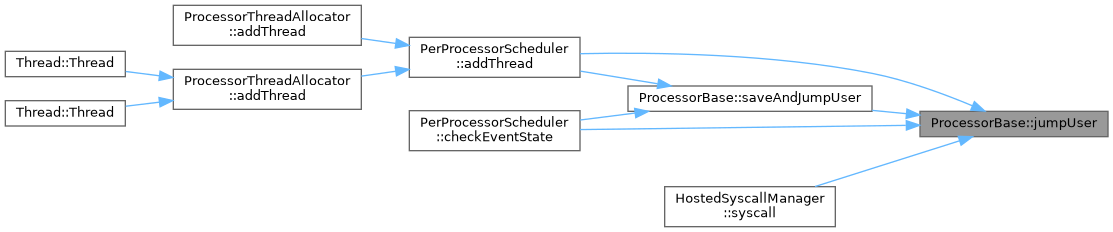
◆ pause()
|
static |
Pause CPU during a tight polling loop.
Definition at line 180 of file arm64/Processor.cc.
Referenced by Spinlock::acquireContended(), X86CommonPhysicalMemoryManager::PageStack::allocate(), LocksCommand::checkState(), AtaDisk::doRead(), Rtc::drainRemoteAlarmDispatch(), Rtc::initialise2(), panic(), PciAtaController::PciAtaController(), DebuggerIO::readCli(), Ne2k::send(), Debugger::start(), TimerHandlerRegistry::unregisterHandler(), Rtc::waitForUpdateCompletion(), and AtaDisk::writePageBuffer().
Here is the caller graph for this function: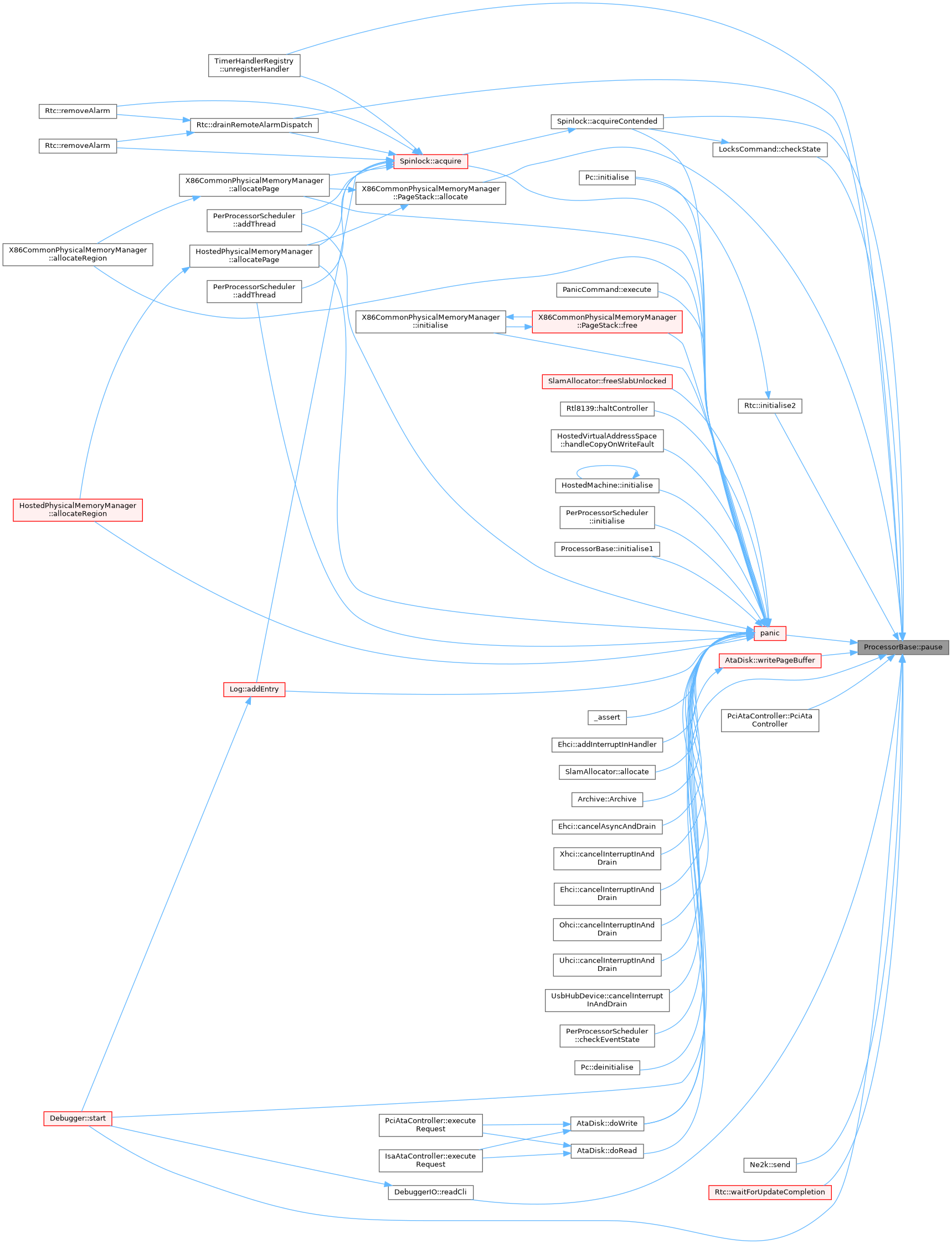
◆ reset()
|
static |
Reset this processor
Definition at line 184 of file arm64/Processor.cc.
References Machine::finalShutdown(), and halt().
Referenced by Machine::finalShutdown(), Pc::finalShutdown(), and HostedInterruptManager::interrupt().
Here is the caller graph for this function: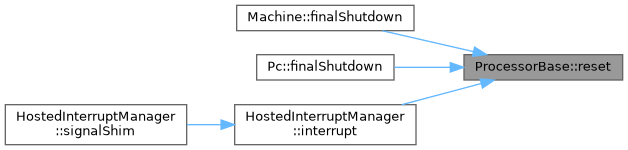
◆ restoreState() [1/2]
|
static |
Restore a previous scheduler state.
- Parameters
-
[in] state The state to restore. [out] pLock Optional lock to release.
Definition at line 69 of file arm64/Processor.cc.
Referenced by PerProcessorScheduler::addThread(), PerProcessorScheduler::eventHandlerReturned(), switchState(), switchState(), and X64SyscallManager::syscall().
Here is the caller graph for this function: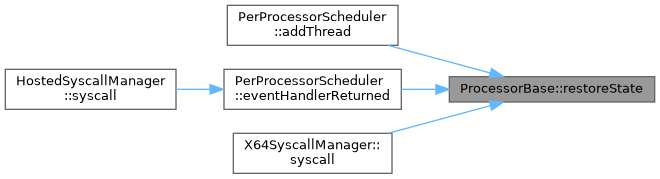
◆ restoreState() [2/2]
|
static |
Restore a previous syscall state.
- Parameters
-
[out] pLock Optional lock to release (for none, set as 0) [in] state Syscall state to restore.
Definition at line 73 of file arm64/Processor.cc.
References information().
◆ saveAndJumpKernel()
|
static |
Jumps to an address, in kernel mode, and sets up a calling frame with the given parameters. Saves the current state before doing so.
- Parameters
-
bInterrupts Interrupt state to restore in saved context. pLock Optional lock to release. address Address to jump to. stack Stack to use (set to 0 for current stack). param1 First parameter. param2 Second parameter. param3 Third parameter. param4 Fourth parameter.
Definition at line 95 of file arm64/Processor.cc.
References jumpKernel(), saveState(), and setInterrupts().
Referenced by PerProcessorScheduler::addThread().
Here is the caller graph for this function:
◆ saveAndJumpUser()
|
static |
Jumps to an address, in user mode, and sets up a calling frame with the given parameters. Saves the current state before doing so.
- Parameters
-
bInterrupts Interrupt state to restore in saved context. pLock Optional lock to release. address Address to jump to. stack Stack to use (set to 0 for current stack). param1 First parameter. param2 Second parameter. param3 Third parameter. param4 Fourth parameter.
Definition at line 105 of file arm64/Processor.cc.
References jumpUser(), saveState(), and setInterrupts().
Referenced by PerProcessorScheduler::addThread(), and PerProcessorScheduler::checkEventState().
Here is the caller graph for this function:
◆ saveState()
|
static |
Save the current processor state.
- Parameters
-
[out] state SchedulerState to save into.
- Returns
- False if the save saved the state. True if a restoreState occurs.
Definition at line 65 of file arm64/Processor.cc.
Referenced by PerProcessorScheduler::addThread(), PerProcessorScheduler::addThread(), PerProcessorScheduler::checkEventState(), saveAndJumpKernel(), saveAndJumpUser(), switchState(), and switchState().
Here is the caller graph for this function: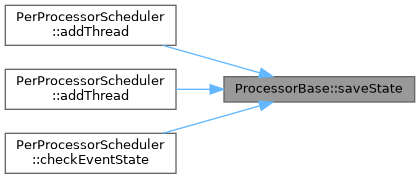
◆ setInterrupts()
|
static |
Enable/Disable IRQs
- Parameters
-
[in] bEnable true to enable IRSs, false otherwise
Definition at line 149 of file arm64/Processor.cc.
Referenced by Spinlock::acquire(), PerProcessorScheduler::addThread(), PerProcessorScheduler::addThread(), PerProcessorScheduler::checkEventState(), Thread::completeAffinityAtSafePoint(), IrqHandlerRegistry::dispatchThreaded(), AtaDisk::doRead(), PerProcessorScheduler::eventHandlerReturned(), Thread::TemporarySignalMask::finish(), Rtc::getTickCountNano(), haltUntilInterrupt(), PerProcessorScheduler::idleUntilInterrupt(), Rtc::initialise2(), Rtc::initialiseProcessorClock(), PosixSubsystem::invoke(), PosixSubsystem::kill(), panic(), Thread::popState(), Thread::pushState(), VirtIrqManager::registerHardIsaIrqHandler(), VirtIrqManager::registerSchedulerIrqHandler(), Spinlock::release(), Process::releaseVforkAddressSpace(), NMFaultHandler::restoreCurrentThreadFpuState(), Thread::retainTemporarySignalWaitInterruptionOrClear(), X64InterruptManager::returnFromInterrupt(), saveAndJumpKernel(), saveAndJumpUser(), NMFaultHandler::saveCurrentThreadFpuState(), PerProcessorScheduler::schedule(), PerProcessorScheduler::setClockDeadline(), HostedInterruptManager::signalShim(), switchState(), switchState(), PedigreeCSyscallManager::syscall(), HostedSyscallManager::syscall(), X64SyscallManager::syscall(), VirtIrqManager::unregisterHandler(), VirtIrqManager::unregisterSchedulerIrqHandler(), AtaDisk::writePageBuffer(), and Process::~Process().
Here is the caller graph for this function: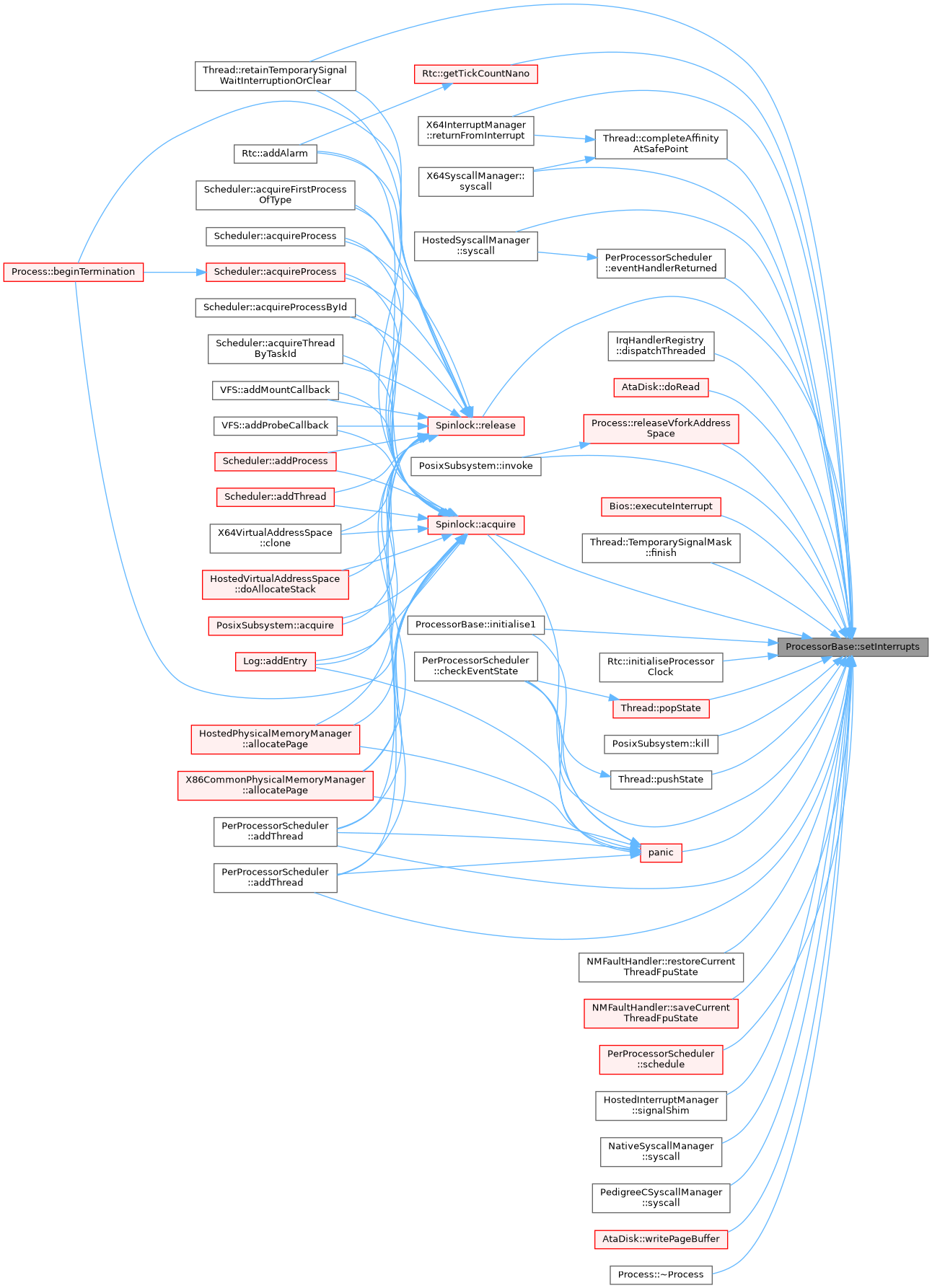
◆ setSingleStep()
|
static |
Enable/Disable single-stepping
- Parameters
-
[in] bEnable true to enable single-stepping, false otherwise [in] state the interrupt-state
Definition at line 208 of file arm64/Processor.cc.
Referenced by StepCommand::execute(), TraceCommand::execute(), and Debugger::interrupt().
Here is the caller graph for this function: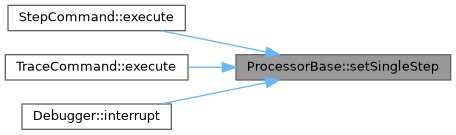
◆ setTlsBase()
|
static |
Set a new TLS area base address.
Definition at line 145 of file arm64/Processor.cc.
Referenced by PerProcessorScheduler::addThread(), PerProcessorScheduler::addThread(), PerProcessorScheduler::initialise(), Thread::resetTlsBase(), and Thread::setTlsBase().
Here is the caller graph for this function: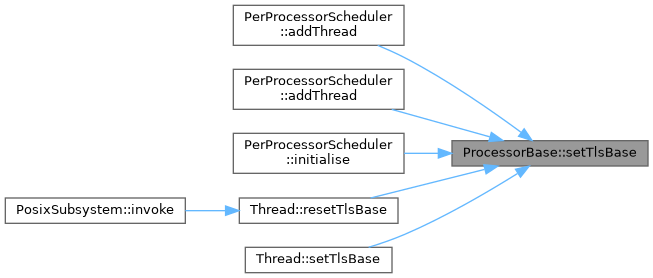
◆ setUserGsBase()
|
static |
Definition at line 230 of file x64/Processor.cc.
◆ switchAddressSpace()
|
static |
Switch to a different virtual address space
- Parameters
-
[in] AddressSpace the new address space
Definition at line 49 of file arm64/Processor.cc.
References VirtualAddressSpace::getKernelAddressSpace(), and information().
Referenced by PerProcessorScheduler::addThread(), PerProcessorScheduler::addThread(), MemoryMapManager::compact(), Process::releaseVforkAddressSpace(), PosixSubsystem::~PosixSubsystem(), and Process::~Process().
Here is the caller graph for this function: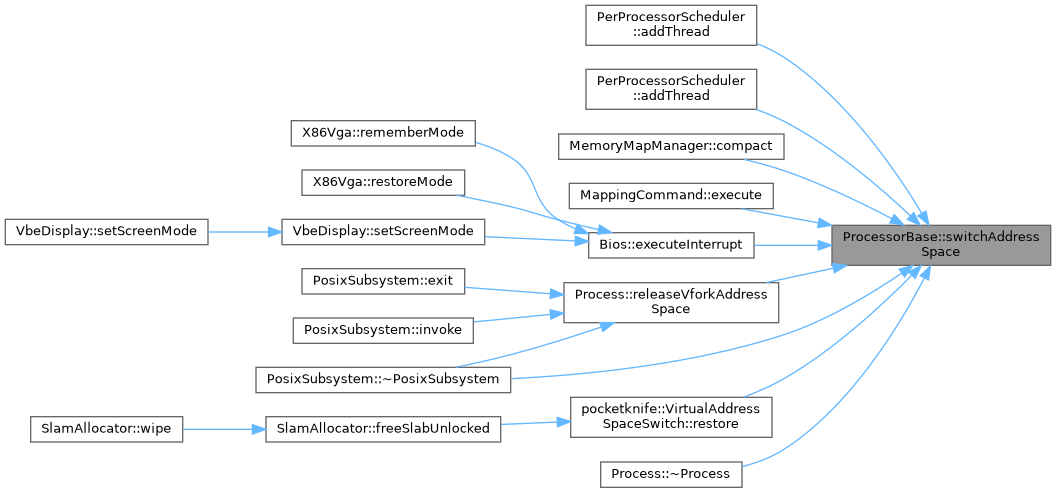
◆ switchState() [1/2]
|
static |
Switch between two states, safely.
Definition at line 77 of file arm64/Processor.cc.
References restoreState(), saveState(), and setInterrupts().
Referenced by PerProcessorScheduler::addThread().
Here is the caller graph for this function:
◆ switchState() [2/2]
|
static |
Switch between two states, safely.
Definition at line 86 of file arm64/Processor.cc.
References restoreState(), saveState(), and setInterrupts().
◆ tlbInvalidationFailureActive()
|
static |
True after a failed invalidation has permanently closed admission.
Definition at line 252 of file arm64/Processor.cc.
◆ tlbInvalidationTerminal()
|
static |
True while page-table mutation admission is permanently closed.
Definition at line 255 of file arm64/Processor.cc.
Referenced by panic().
Here is the caller graph for this function: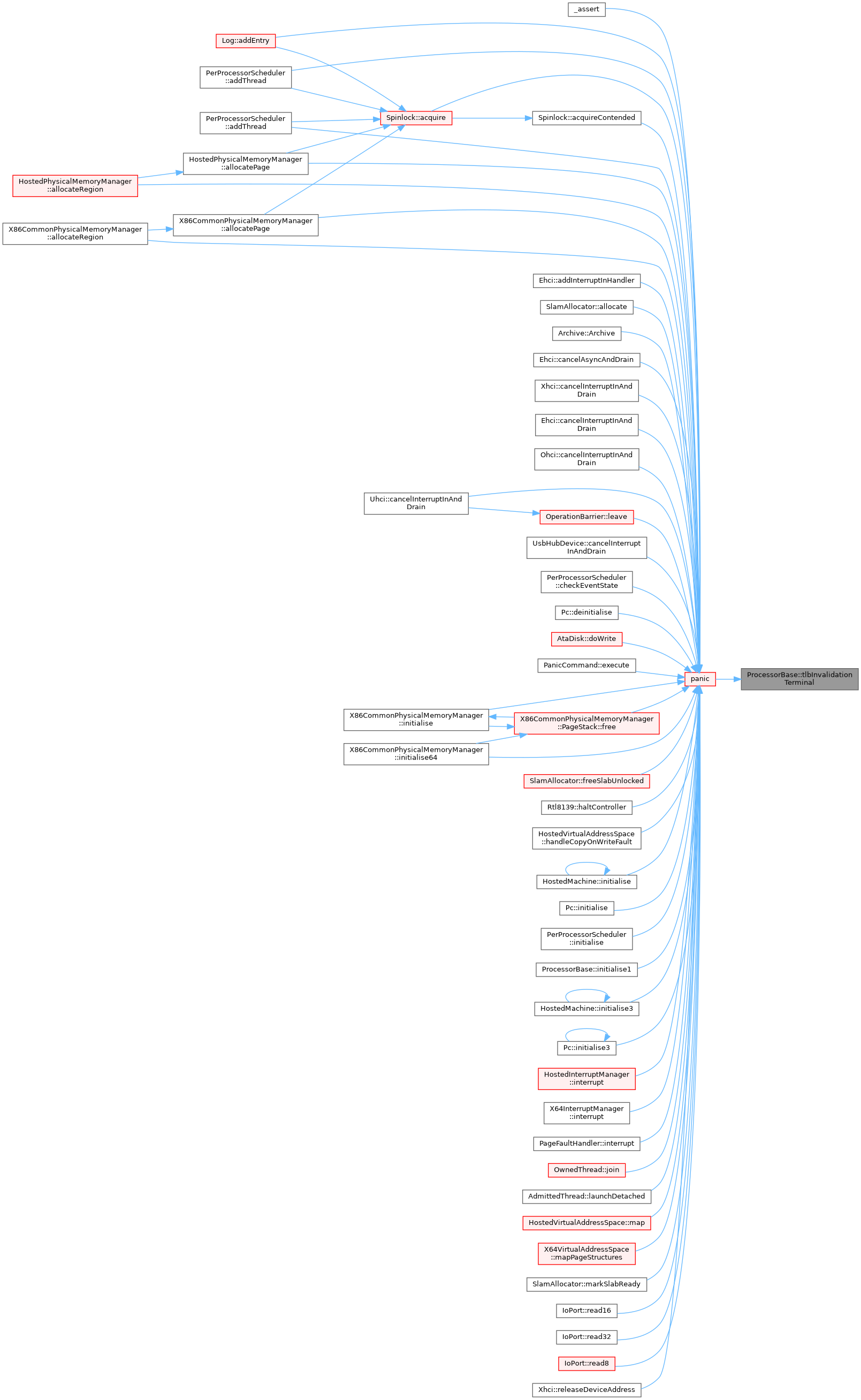
Friends And Related Symbol Documentation
◆ Multiprocessor
|
friend |
Definition at line 130 of file Processor.h.
◆ Scheduler
|
friend |
Definition at line 134 of file Processor.h.
◆ TlbInvalidationGuard
|
friend |
Definition at line 131 of file Processor.h.
◆ X64GdtManager
|
friend |
Definition at line 133 of file Processor.h.
◆ X86GdtManager
|
friend |
Definition at line 132 of file Processor.h.
Member Data Documentation
◆ m_BootstrapKernelGsAnchor
|
staticprivate |
Definition at line 42 of file Processor.h.
◆ m_Initialised
|
static |
How far has the processor-specific interface been initialised
Definition at line 483 of file Processor.h.
Referenced by _assert(), SlamAllocator::allocate(), Arm64PhysicalMemoryManager::allocatePage(), Armv7PhysicalMemoryManager::allocatePage(), HostedPhysicalMemoryManager::allocatePage(), X86CommonPhysicalMemoryManager::allocatePage(), MemoryPressureProcessKiller::compact(), MemoryPressureManager::compact(), Arm64PhysicalMemoryManager::freePageUnlocked(), Armv7PhysicalMemoryManager::freePageUnlocked(), HostedPhysicalMemoryManager::freePageUnlocked(), X86CommonPhysicalMemoryManager::freePageUnlocked(), initialise1(), initialise2(), PageFaultHandler::interrupt(), isInitialised(), X64VirtualAddressSpace::mapPageStructures(), and X64VirtualAddressSpace::mapUnlocked().
◆ m_nProcessors
|
staticprivate |
Definition at line 518 of file Processor.h.
◆ m_ProcessorInformation
|
staticprivate |
If we have only one processor, we define the ProcessorInformation class here otherwise we use an array of ProcessorInformation structures
Definition at line 512 of file Processor.h.
Referenced by informationAt(), Scheduler::initialise(), and X64GdtManager::initialise().
◆ m_SafeBspProcessorInformation
|
staticprivate |
Used before multiprocessor stuff is turned on as a "safe" info structure. For stuff like early heap setup and all that.
Definition at line 516 of file Processor.h.
Referenced by informationAt(), and initialise1().
The documentation for this class was generated from the following files: